Showing posts with label medieval Florence. Show all posts

Sunday, November 30, 2014

Snapshot: Florence, 1338


In my last post I promised a look at Florence's medieval population figures, with at least a cursory glance at our sources for that information and the processes historians use to figure out how many people lived in a given place at a given time.

But before we go into generalities, I'd like to take a look at one specific -- and extraordinary -- source for Florence, circa 1338.

In 1338, the ravages of the Black Death are still ten years in the future, though other pestilences have recently wrought havoc on a smaller scale, as have natural disasters and food shortages.  Dante has been dead for 17 years.  Florence's extraordinary century of growth -- the 13th century -- is over, and Florence is now the dominant military and commercial power in Tuscany.  She is a wealthy city, and much of her wealth comes from the wool industry.  Her merchants and bankers are famous throughout the world.

And one proud Florentine, the chronicler Giovanni Villani, elected to give us a detailed portrait of his city, including numbers.  Lots of numbers.  There is, of course, no way to verify his every claim, but modern historians have generally been impressed with how closely his figures tally with those they've arrived at after much forensic work.   

Giovanni Villani

Villani was in a good position to give us this snapshot of his city in the year 1338.  Born into a prosperous merchant family, he was a banker and a public servant as well as a historian.  He was an agent, a shareholder, and eventually a partner in the famous Peruzzi banking company; a member and sometime officer of the powerful Arte di Calimala (wool-finishers guild); and he served his city as one of its  priors (the nine-member elected government) on several different occasions.  In addition to that, he was deputized in 1324 to oversee the rebuilding of the city's walls, and after the famine of 1328 he served as a magistrate in charge of provisioning the city and distributing grain to the citizens of Florence. He also served in the Florentine army.

He knew Florence, knew her physical properties, her politics, her business ventures, her military activities, her people.

Here are a few of the things he has told us about Florence in 1338:

First, based on the consumption of grain, he calculated that Florence had about 90,000 mouths to feed.   Modern scholars believe the total population to have been somewhere between 100,000 and 120,000 at that time; however, Villani explicitly says that he did not include members of religious orders or foreigners (foreigners being non-citizens, and there would have been a lot of them because of the influx of people from the countryside during the recent famine, people who wanted to take advantage of Florence's grain provisions).  Allowing for those two categories, Villani's figures appear to be fairly accurate.

Distribution of grain

He tells us that about 25,000 men between the ages of 15 and 70 were capable of bearing arms, and in time of war they would be joined by another 80,000 men from the surrounding countryside (the contado).


Between 5,500 and 6,000 infant baptisms were performed in Florence's Baptistery that year.

Three views, old and new, of the Baptistery

Some 8,000 to 10,000 children, both boys and girls, were learning to read in elementary schools.  Six hundred boys were enrolled in higher level schools to learn grammar and logic.

The city housed 110 churches,  of which 57 were parish churches and the rest belonged to the various religious orders.

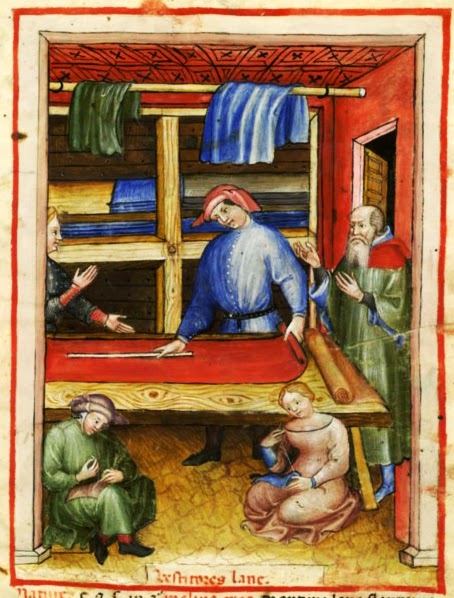
Over 200 workshops associated with the wool trade employed some 30,000 people, producing 70,000 to 80,000 bolts of cloth with a total value of more than one million two hundred thousand gold florins, a third of which was paid out as wages.

Florence had 80 banks, 600 notaries, 60 physicians and surgeons, and 100 apothecaries to serve its populace.

Apothecary

In a year the city went through enough grain and wine and meat animals to allow us to say that each individual in the city consumed, on average, 530 pounds of grain, 54 gallons of wine, and 88 pounds of meat, according to the calculations in Gene Brucker's book Florence: The Golden Age, 1138-1737. That meant a total of 4,000 cows and calves per year, as well as 60,000 geldings and sheep, 20,000 goats, and 30,000 pigs.


Brucker also has an interesting diagram that illustrates the population breakdown.  Out of 500 people representing a cross-section of the entire population of Florence, he tells us, the distribution includes the following:
  • 1 moneylender or judge
  • 2 priests
  • 1 monk
  • 3 nuns
  • 60 scholars: 3 studying grammar, 7 studying the abacus, and 50 learning to read
  • 3 notaries
  • 1 doctor or apothecary
  • 1 baker
  • 139 (potential) soldiers
  • 8 noblemen
  • 2 merchants traveling outside the city
  • 8 foreigners (visitors or soldiers) 
  •  168 earning their living from the wool trade (one of whom actually owned a wool workshop)
There's more, but that should be enough to give you an overview of the bustling  metropolis of Florence in that long-ago year.  Next time I'd like to discuss a few of the potential pitfalls in trying to calculate population from the two main figures typically used for that purpose (grain consumption and baptisms), and also to find ways to visualize exactly how populous Florence was at various times in her history.

 Images in this post are in the public domain.


Tuesday, November 18, 2014

The Medieval Italian City


Herewith I want to start a new thrust to this blog.  For a long time I've described myself as interested in Italy in the middle ages, as Dantecentric, as someone who wants to understand what came before the Renaissance.  All of that is still true, but when I think about the settings I choose when I write, I've realized that they all have one thing in common.

All my work takes place in medieval cities.

True, they were crowded, dirty, noisy, chaotic, malodorous, pestilential, dangerous, and politically volatile.  But they were where the action was. They were teeming with life and color and creativity and passion and ambition – in short, with all things human.  When Florence's population quadrupled over the course of the thirteenth century, it wasn't the birthrate that did it – it was immigration from the hinterlands.  There were reasons all those people wanted to try their luck in the city.

I've read  some wonderful medieval stories set in rural areas, in villages (one that comes to mind is Ann Baer's Down the Commons: A Year in the Life of a Medieval Woman, which is somewhere between a rural setting and a village), in some noble guy's castle, on the road (a wonderful new “on the road” book is Lucy Pick's Pilgrimage, much of which unfolds along the pilgrimage route to Santiago de Compostela).  There's nothing wrong with any of that, much that's right, and much that I need to know and understand about those settings to be able to make sense of urban life.  But for me, it's all about the cities.


When we go to Italy you'll never find us in some agriturismo place, some picturesque villa out among the cypress trees.  Not that it wouldn't be fun to be there, but knowing me, I'd just keep heading into the nearest city anyway, so we might as well stay there.  And not just in the city, but smack dab in the middle of the historic center, as medieval and as urban as we can get.  And in an ancient and historic building, if at all possible (and if they can get internet signal through those thick walls...).

Sometimes at night, or in the rain or snow, or at sunrise, it's possible to glimpse the city as it was, if only briefly.  And for me, those moments are worth traveling for. 

Of course, once in a while things go awry.  This, for example, was supposed to be the most beautiful piazza in Italy:


Obviously our timing was a little off.

My first novel, A Thing Done, takes place in Florence in the early 13th century.  It unfolds in the palazzos, the towers, the churches, the narrow and winding streets of the middle ages.  The story it tells is drawn from the ancient chronicles (and fleshed out a bit), and it traces the development of a pivotal incident in the history of this extraordinary city.  Today's Florence is at once modern, baroque, and Renaissance; if you want to find the middle ages, they're still there, but you have to work at it.  And I have. 

Here is a tower that was the scene of a major event in my novel. 


Today it houses a jewelry store, and it's a fraction of its former height – the government of Florence, during the brief period when it was controlled by neither the Guelfs nor the Ghibellines but by the popolo, required the nobles to reduce the height of their formidable defensive towers, in an effort to contain the lawlessness and the sheer military might of those powerful families.  Thus, the vertiginously scary balcony which so terrified my protagonist is long gone, but the base of the tower remains.  (See here for more on medieval towers.)

And here is a church where another major scene takes place.  It's now a library.


Here are a few links to earlier blog posts in which I've discussed some aspects of medieval Florence:
Was There a Florence Before the Renaissance?

Exercising Your Imagination, Part 1 and Part 2

So - What's It About?

What Building Most Defines Medieval Florence?

My work in progress alternates between two cities, Assisi and Rome, in the same time period.  Assisi is still very medieval in its aspect, and it's easy to walk down those ancient streets and let your imagination wander.  You don't have to work very hard at all, in Assisi, to go medieval.  (See here, here, and here for a few pictures of this lovely city.)

Rome, on the other hand, presents some challenges.  It is now a big, noisy, aggressive, modern city.  I wouldn't even bother with it, except – well, it's Rome.  What can you say?  Stuff happened there.

Rome presents the tourist/researcher with some truly bizarre contradictions.  Like this one:


The traffic is fierce.  You take your life in your hands crossing a street.  It's not quite the worst I've seen.  (That would be Naples, where the traffic is so gonzo it's almost fun, in a suicidal sort of way.)  But it's plenty bad enough. In Rome, we discovered that the only way you can cross a street in relative safety is to attach yourself firmly to one of the following:

  • a nun
  • an old woman
  • someone pushing a baby carriage

In fact, I'd only feel really safe in the company of an elderly nun pushing a baby carriage. 

Romans, thinking about crossing the street

And Rome keeps changing.  Giacoma, the main character in my WIP, lived in a fortified palace that incorporated the ancient ruin of the Septizonium.  Here's what would have been left for me to see if I had been in Rome in the 16th century:


And here's what's there now:


Despite the difficulties and frustrations, I do love learning about medieval Italian cities.  In my next post, I will be discussing population – specifically, the population of Florence.  This may, in fact, turn into two posts, one on how the population figures are derived (it's not as simple as glancing at a census), and a second on the actual figures, put into context, and on how they shifted over the medieval time period.  Hope you'll join me for this excursion into medieval demographics.

Images in this post are our own, or in the public domain.

Saturday, October 18, 2014

The box liked it


My historical novel A Thing Done, set in Florence in 1216, is now on sale.  For the next month, more or less, we've dropped the price drastically for ebook versions on Amazon, Barnes & Noble, and iTunes, and lowered the price on the paperback as well.  It's now going for $3.50 for Kindle, $2.50 for Nook, and $2.99 for iTunes ebook version.  (I have no idea why those prices are different.  I just work here.) 

If you haven't read it yet, I recommend it.

"Of course she recommends it," I hear you saying.  "She wrote it."

Once, when my husband brought home a DVD, I asked him why he had chosen that particular film.  His answer?  "Well, the box liked it."

The box always likes it.  But I don't always love things I've created, after the fact.  Some of them actually make me cringe.  It's like when my husband and I record music:  when we play it back, I hate it.  I hear everything that could have been better, everything that isn't quite good enough, everything that could have been played more elegantly.

But this book I still like.  I'm not saying it's perfect, but I liked writing it, I liked having written it, and - most amazing of all - I even liked reading it.  And I think you might, too.

Medievalists.net liked it (read their review here):  "I've read a lot of historical novels over the last few years but I have to say that hands down, this one is at the top of my list," wrote Sandra Alvarez.  It makes me happy to know that people who are familiar with the underlying history enjoy my book.

The Sharp Writ Book Awards liked it.  It shared the top prize in the fiction category with another book, so now it gets to wear a little gold ribbon, and I have a plaque sitting on my bookcase:


Lots of kind people have told me they enjoyed it, so I don't hesitate to recommend it now.  And doing so reminds me of some of the more memorable ups and downs in the saga of trying to sell copies of this book since it was published in October 2012.

Here's the blurb, as it appears on the book cover:

In 1216 the noble families of Florence hold great power, but they do not share it easily.  Tensions simmer just below the surface.  When a jester's prank-for-hire sets off a brawl, those tensions erupt violently, dividing Florence into hostile factions.  A marriage is brokered to make peace, but that fragile alliance crumbles under the pressure of a woman's interference, a scorned bride, and an outraged cry for revenge.

At the center of the conflict is Corrado, the Jester, whose prank began it and who is now pressed into unwilling service by both sides.  It will take all his wit and ingenuity to keep himself alive, to protect those dear to him, and to prevent the unbridled ambitions of the nobles from destroying the city in a brutal civil war.

Many different versions of this blurb exist, because one must try many different things to sell books.  There was the one where I tried it in question form:
Will Buondelmonte's reckless act set off a full-scale vendetta?  And if it does, will even the Jester's famous wit and ingenuity be enough to keep himself alive and protect those dear to him?
 (Answers:  Yep.  And no, not exactly.)

Pleeeeease buy this book!

Sometimes I added more description:
Sworn to secrecy, he [Corrado] watches in horror as the headstrong knight Buondelmonte violates every code of honor to possess the woman he wants, while another woman, rejected and enraged, schemes to destroy him.
I'll do anything to get you to buy this book

I did want to stress the importance of the role of women in this book, since the Jester is male.  So I added this paragraph:
This is Corrado's story, but it is also the story of three fiercely determined women in a society that allows them little initiative:  Selvaggia, the spurned bride; Gualdrada, the noblewoman who both tempts Buondelmonte and goads him; and Ghisola, Corrado's great-hearted friend.  From behind the scenes they will do what they must to achieve their goals - to avenge, to prevail, to survive.
Buy this book or the peacock gets it.

But these days you can't make your spiel longer.  You have to make it ever shorter and more succinct.  I learned that when I discovered Twitter.

You don't get a lot of room to work with on Twitter, and you have to save room for links and hashtags and so on.  If I want to call the book "prize-winning" it will cost me 13 characters.  If I write #buythisbookdammit, it will cost me 18.  And I absolutely refuse to write things like "U r gr8!"  I. Just. Won't.  It's all I can do to stop myself from leaving two spaces between sentences.  Left to my own devices, I'd probably tweet with footnotes.

When my son was very small, he was bouncing up and down in his crib when the bottom gave way, and he tumbled to the floor in a pile of mattress, blankets, and stuffed toys.  He was unhurt, but the whole thing was terribly exciting and he wanted to tell me about it.  Only problem was, he hadn't exactly figured out speaking in full sentences yet.  So he ran up to me and yelled, "Mommy!  Bed!  Down!  Uh-oh!  Wow!"

That kid would have been a natural, had Twitter existed back then.

No so his mom, however.  But I did manage a few I liked.  There was the Shakespeare pair:
"where civil blood makes civil hands unclean": Will could have been talking about A Thing Done.

"from ancient grudge break to new mutiny": The Bard could have said it about A Thing Done.
The book takes place over Easter in 1216, so I did some seasonal tweets on the appropriate days:
The history: Good Friday 1216, Florence - the calm before the storm.

The history: Holy Saturday 1216, Florence - a knight is running out of time.

The history: Easter 798 years ago, Florence - Vendetta. Ambush. Civil war.
I used the first line of the book:
It was a fool that began it, but it took a woman to turn it murderous. Florence, 798 years ago.
And my favorites:
A tale of vendetta, betrayal, a spurned woman, civil war, and juggling.

What happens when a knight can't take a joke?
I'm still considering this one:
Price slashed (Also some of the characters, come to think of it.)
After a while, one gets a bit burned out with this sort of thing, and one might even start to get a little silly around the edges.  (Ya think?)  Then you find yourself thinking up marketing ploys like the pictures above, and these:

Drumming up some support for this book

Ta-da!  Historical novel on sale, cheap!

You try dressing up like your main character:


You dress up your musical instrument like your main character:


Then things really went downhill, and I came up with these:


 If you've stayed with me this long, you'll realize that no matter what you think of my book, I'm a better writer than I am a saleswoman.  I'd pretty much have to be.  You should also, despite all the silliness, have a pretty good idea by now what the book is about.  I hope I've piqued your interest, and that you'll acquire the book, read it, and enjoy it. 

And if you'd like to read a bit more about it in a more serious vein before deciding, you could always take a look at my website, or at my author page on the website of my publisher, Fireship Press. 


Images of the gallery and of Putin and his colleagues come from a fun site called PhotoFunia.  Pulp covers are from Pulp-o-Mizer.

Sunday, May 18, 2014

Medieval Moms II: The Saint

Reliquary of Beata Umiliana de' Cerchi, Museo di Santa Croce, Florence

The Blessed Umiliana dei Cerchi, speaking of her children:
O how blessed they would be if they were to die so unstained, still bearing their virginity.  If it is God's will, I would prefer that they die and go to glory rather than live, lest at some time they offend God and so lose a portion of the eternal inheritance. - quoted in Carol Lansing's book The Florentine Magnates
Umiliana's daughter Regale (imagined response):
Um... Mom?

Have you ever heard anyone say, "My mother is a saint"?  It's just possible that might not be an entirely good thing, from a child's point of view. 

(Most sources list Umiliana as "Beata," or "Blessed," rather than as "Saint," but I've seen it both ways.  I'm writing this post as her feast day, May 19, approaches, 768 years after her death in 1246.)

So who was this lady?  Umiliana (aka Humiliana, Emiliana) was born around 1219, into a wealthy Florentine family.  The Cerchi were bankers, influential in Florentine politics and becoming ever more so (they were to become the main opposition to the family of last week's blog topic, Tessa Donati - read about her here).

Cerchi coat of arms, Santa Maria Novella (Florence)

At sixteen, Umiliana married a member of the Buonaguisi family (we don't know his name).  Shortly after her marriage, and probably under the influence of her sister-in-law Ravenna, she rejected “the pomp and adornment of the world.”  She would not paint her face; she cut off the bottom of a beautiful new tunic her husband had given her, made sleeves out of the cloth, and sold them, giving the money to the poor.  She collected her old clothes and her husband's and gave those to the poor, and when she had cloth to make sheets, she made them shorter than usual and gave the rest of the cloth away.


She was also said to give away “all the linen which she found in her husband's chamber.”  I don't know whether that meant bed linens only, or if she also gave away the unfortunate man's shirts and underwear.  She even removed feathers from the marital mattress, to make a pallet to give to a hospital.


She was contented with coarse food, and “took the food out of her mouth, reseasoned it, and gave it to the poor.”  (I know – yuck.  Let's agree not to take that literally, shall we?)  She also stayed up late at night to prepare food for the poor.  She and Ravenna would distribute it the next day, bringing along servants to help carry.


Needless to say, her husband and his family were not gruntled about all of this.  (At least the male members of the family were not; Umiliana seems to have had a wonderful rapport with their womenfolk, many of whom testified to her sanctity after her death.)

As Umiliana's biographer, Fra Vito of Cortona, tells it, her husband and his male relatives (and later her own male relatives) opposed her efforts, every step of the way.

But can you blame her husband?  His young trophy wife is running around in unfashionably short clothes; she's giving away his underwear, stoking the cookfire and cooking all night, and his bed is short-sheeted and missing a lot of feathers.  This was probably not what he bargained for.  As one historian said, “Umiliana did not so much reject marriage as subvert it.”


But we wanted to look at Umiliana as a mother.

Her husband died after a few years of marriage and the birth of two daughters.  Umiliana spent the next year in her family's home, always increasing her charitable efforts, to the displeasure of her husband's brothers, and then she moved back to her father's house.

Her children stayed behind.  Medieval Florentine society believed that's where they belonged as part of their father's lineage.

Did Umiliana have any choice in the matter?  Some men made provision in their wills for their widows to stay in the family home as long as they remained chaste, but we don't know if that happened in Umiliana's case.  Did her husband's family become exasperated and order her out (fearing, perhaps, for their underwear)?  Did she choose to leave?  Did her father, who wanted to use her in another dynastic marriage, insist?

We don't know.  We do know that she left the girls behind, probably in the care of her beloved sister-in-law Ravenna.  We know that members of her birth family tried in vain to persuade her to agree to marry again.  We know that she wanted to enter a convent of Poor Clares at Monticelli, but she was not accepted, so she took up residence in a cell in her father's tower and continued her charitable efforts as a Franciscan tertiary from there (attended by servants from her father's household).

Cerchi tower (shorter than it would have been then)

We also know that Umiliana's father, Oliviero dei Cerchi, reclaimed the right to her dowry, which she claimed he did by deceiving her so that now she would live in her father's home “as a servant, not as a daughter.”  The lack of control over her dowry severely limited how much she could give away to the poor (and some historians believe that Oliviero was merely trying to prevent her from giving away what must have been a considerable sum of money).  Lack of dowry may also have been why she was rejected by the convent – while the Poor Clares espoused poverty, the fact remained that most of the nuns in that Florentine religious house were from wealthy and powerful families, and entered with a dowry.

Umiliana did love children.  She had visions of the Christ child; she once tried to capture the Holy Spirit in the form of a dove to give to her little nephew; she visited a sick boy and voluntarily took his suffering upon herself.

It is said that a demon tried to tempt her out of a vow of silence by showing her visions of various kin lying dead, which would require her to mourn them vocally, and that one such vision was of her two daughters lying on a pallet at her feet, but she successfully resisted this temptation.

And one telling incident:  her daughter Regale (or Rigale) was visiting Umiliana in her tower room one day shortly after terce (mid-morning) when the child was struck dumb, then fell down as if dead, turning very white.  Umiliana, distraught, tried to revive her, but perceiving no breath, she believed her daughter had died.  Fra Vito tells us she feared the trouble this would bring down on her head when her husband's relatives learned of it (emphasis mine), so she prayed to an image of the Virgin.  Then a beautiful child appeared and made the sign of the cross over the little girl, who sat up, fully conscious and completely well.

Santa Margherita dei Cerchi (church in Florence under the patronage of the Cerchi and other neighborhood families in the 13th century)

Rudolph Bell, in his book Holy Anorexia, claims that Umiliana's inlaws believed she was not a fit mother.  Yet they did permit the child to visit her -- unless that was done solely on Ravenna's initiative, which seems possible.  As we have seen, the fact that Umiliana left the girls with her husband's family may well not have been her choice.

Was she as lacking in human feeling for her daughters as some of these quotes and anecdotes seem to suggest?  I wouldn't be too sure.  Everything we read is filtered through her Franciscan biographer, who was trying to depict the life of an urban Franciscan tertiary as he saw it (and this was still early days for the Franciscan order, which was still establishing itself in Florence – Umiliana was seven years old when St. Francis died).

But at the hearings about her sanctity, she was supported not only by three Franciscan friars, but also by 30 women, many of whom were members of her own or her husband's family.  I find it hard to believe that would have been the case if they had seen her as an inadequate mother.  Once again, we are peering far into the past, without much information to work with, and we need to be very careful not to judge people of another time by the standards of our own.

We do not know what eventually became of Regale and her sister.


Next week:  Medieval Moms III:  The Sinner.


Images in this post:  Reliquary photo is licensed to Sailko via the Creative Commons Attribution-Share Alike 3.0 Unported license, Wikimedia Commons. So are the photos of the Cerchi coat of arms, the Cerchi tower, and the church of Santa Margherita dei Cerchi.  Other images are in the public domain.

Sunday, May 11, 2014

Medieval Moms I: One of the "Ill-Famed"

This could have been a block party in the Sesto dello Scandalo, Florence

Corso Donati's mom was quite a lady.  She lived in turbulent times, and the large and powerful family she married into had certainly made its own substantial contribution to that turbulence, with plenty more to come.

The Donati and their rivals the Cerchi lived in the same small neighborhood in Florence, those last decades of the 13th century.  Rivalries and festering hatreds exploded into violence with such regularity there that the cluster of houses and towers officially called Porta San Piero was known informally as the "Sesto dello Scandalo."  (And the Donati were known as the "Malefami," or Ill-Famed; hence the title of this post.)  Contessa, called Tessa, could have been that lady in the picture about to drop a large rock on some poor guy who looks like he has enough problems already.

The neighborhood today (with two Donati towers still dominating it)

We don't know Tessa's birth family, unfortunately.  We do know that she married messer Simone Donati ("messer" indicates that he was a knight) and was mother to at least three sons and two daughters. 

Well, actually we don't even know that.  Recently some scholars have discovered a tomb in the excavations of Florence's old cathedral, Santa Reparata (under the present cathedral) indicating the resting place of one Ioanna, wife of Simone Donati.  But since we don't know how long Tessa lived, Ioanna could have been a second wife, or she could have been wife to a different Simone, since the name recurred in every generation of this large family.

Assuming Tessa was, as most believe, mother to Corso and his brothers and sisters, she must have had her hands full.  Corso was to become one of the most powerful and dangerous men in a city full of powerful and dangerous men.  Florentine chronicler Dino Compagni was to describe him thus:
A knight in the mold of Catiline the Roman, but more cruel; noble of blood, handsome of body, a charming speaker, adorned with good breeding, subtle of intellect, with his mind always set on evildoing...  he lived dangerously and died reprehensibly.  He was full of malicious thoughts, cruel and astute.
Corso (on horse)
But today we want to concentrate on Tessa herself, not on her frequently problematic offspring.  What do we know of this woman, who lived so long ago? 

Tessa had another son, Forese, who was a good friend of Dante's.  So good, in fact, that the two of them created a poetic conversation of sorts (a dispute, an exchange of insults, presumably all in good fun) called a tenzone.  In this extraordinary and scurrilous exchange they accuse each other of everything from gluttony to poverty to sexual inadequacy to cowardice to thievery.  In one of Dante's verses, he begins like this:
Bicci novel, figliuol di non so cui,
(s'i' non ne domandasse monna Tessa)
"Bicci novel," or "Bicci Junior," was Forese's nickname.  The phrase means "Bicci Junior, son of we don't know who (unless someone asks monna Tessa."

Ahem.  I guess it shows that insulting the other guy's mother is a practice that goes back a long way.

Forese, as Dante finds him in Purgatory (Gustave Doré, 1832-1883)

But that's not the only account of Tessa that survives.  The Lucchese writer Giovanni Sercambi, 1348-1424, wrote a collection of 155 short stories, one of which told a tale of monna Tessa.  His life did not overlap with hers, but he was recording stories that lived in popular memory from less than a century earlier.

It seems that Tessa and her companions were walking along the street near what is now Orsanmichele.  Tessa was an attractive woman, married to an important man, and many people greeted her honorably.  Among them, however, was one man called Bisticcio, who said (and I must thank the eminent Dante scholar and very good sport Christopher Kleinhenz for help with this translation):
"Hey!  Maybe I'll see you in the bordello, so that anyone who would want to sleep with you, be he a townsman or a country dweller, could do so by paying the price."

Tessa heard him.  She told her companions to stop; she turned and faced him.  "Bisticcio," she said, "why do you insult me?  No matter who of you might want to come to bed with me, you could not have me except by paying top dollar."

And then she left, courteously.  Bisticcio was ashamed, for he didn't think the lady had heard him.
I suppose the modern version would be something like, "Hey, babe, how about it?"  "Forget it - you can't afford me."

On the strength of these two accounts, Giosuè Carducci, winner of the Nobel Prize for Literature in 1906, sniffed that Tessa "was no Cornelia."  (Cornelia was a favorite example of the noble virtues of Roman womanhood.)

Cornelia, being virtuous
 Many moms have to put up with squabbling children.  But not every mom has to deal with her son (Corso) plucking her daughter (Piccarda) out of a convent and dragging her off kicking and screaming to be married, against her will, to his political ally.   Or, for that matter, Corso driving her other daughter (Ravenna) into a convent, with her children, to escape Corso's marriage plans for her (and his plans for acquiring her recently-inherited fortune) after she was widowed.  That one became a tiresome legal battle between Corso and the nunnery, and it went on for years.  He had no legal right to any of that money, yet somehow he wound up with half of it.  One wonders what Tessa thought of it all.  Did she take sides?  Was she ever tempted to give Corso a time out?

Removing Piccarda from the convent (Lorenzo Toncini, 1802-1884)

During the long years of the Guelf-Ghibelline rift, Tessa endured the pain of exile more than once, relocating with her children to another city, not knowing whether she would ever see Florence again.  Her fortunes fluctuated with the fortunes of her family's political party (Guelf, and later when the Guelfs split into Black and White factions, Black Guelf).  History is silent about any role she may have played in the city's struggles, yet I can't shake the feeling that the woman who could stand up for herself in the street (and could inspire a ribald insult from no less a man than Dante) must have been a player.  Somehow I doubt that she just sat around meekly waiting to see what would happen next.

She was married to a man who, while serving as chief magistrate in another city, was said to have imprisoned a man and put him to the torture, falsely accusing him of a crime, because he wanted to have his way with the man's daughter.  Did Tessa shrug it off?  Was hers a real partnership, or did she and her husband lead separate lives?  We don't know.

 And we really don't know anything about Tessa as a mother.  But Corso was married three times, and while we don't know the name of his first wife, we do know that the second and the third were both also named Tessa.  Oedipus complex, or coincidence?  You decide.


Photo of neighborhood in Florence is licensed to Sailko via the Creative Commons Attribution-Share Alike 3.0 Unported license, via Wikimedia Commons.

Thursday, February 13, 2014

What building most defines medieval Florence?


The other day I was looking through the illustrated Cronica Nuova by Giovanni Villani, a medieval chronicler who lived from ca. 1276 until he died of plague in 1348.  This lavishly-illustrated manuscript dates from the early 14th century, about the time Villani wrote his history of Florence and of other parts of Italy and the world.

The illustrations depict many cities, both close to Florence and far away.  Cities in this time period are shown with towers and other tall buildings, typically sticking up inside a circle of protective walls with formidable gates.  Pretty much every city shown has these characteristics.  And yet, every picture of Florence is unmistakably, distinctively Florence.

What makes it so obvious?  How did people of Dante's time (1265-1321) choose to portray their city?  And what was it that, to the medieval viewer, signaled "Florence" at first glance?

Santa Maria del Fiore

Not the cathedral, Santa Maria del Fiore, with its famous dome by Brunelleschi.  That wasn't built yet.  At the turn of the 14th century, the cathedral was Santa Reparata, a smaller church on the site where the duomo now stands.

Ponte Vecchio

Not the famous bridge over the Arno, now known as the Ponte Vecchio.  Yes, there was a bridge in that spot, and it did have shops lining both sides, but that bridge washed away in the great flood of 1333 and was replaced in 1345 by the bridge you see above.

Both of those pictures are unmistakably Florence, but they are from a period well after Dante.  Neither the cathedral nor the Ponte Vecchio (or, for that matter, the Palazzo della Signoria) is the iconic feature that defined the city in the beginning of the 14th century.

So what was it that defined Florence, for Dante and his contemporaries?  One building:  the Baptistery.


In Dante's day, Florentines believed that the Baptistery had originally been a Roman temple dedicated to the god Mars.  Actually, this version of the Baptistery was built somewhere around the middle of the 11th century, though it was raised on the foundations of an earlier building or buildings.  An earlier baptistery stood on this space, dating from the 5th or 6th century, and it in turn may have been constructed over a Roman structure of some sort.

Illustration from Villani:  Building the Baptistery

The sides of this iconic building are clad in contrasting white and green marble in geometric patterns.  It is distinctive, and as you will see, it's easy to spot in the illustrations to Villani's history.

The Baptistery, Dante's "bel San Giovanni," is, of course, dedicated to Florence's patron saint, John the Baptist.  Until the end of the nineteenth century, huge mass baptisms were held in this building on Easter Saturday every year.

Villani's Cronica summarizes Florence's early history, as it was understood at the time.  Here's his illustration of Florence being destroyed by Totila:


The walls are down, other buildings are toppled, the defenders of the walls are headless, but there stands the Baptistery, intact and instantly recognizable.

Florentine legend dictates that the city was rebuilt by command of the great Charlemagne:


Note the banners with SPQR, indicating the involvement of Rome (hence, the empire), and the anachronistic fleur-de-lys to suggest Charlemagne.  

The iconic building appears again in depictions of a much later time - the late 12th century, during the intercity struggles between the Guelfs and the Ghibellines:


The walls are higher, the angle is different, but there's the Baptistery, leaving no doubt about what city is being shown here.

The Guelf-Ghibelline wars take up a lot of space in Villani's work, since he lived through a lot of them.  Here's Emperor Frederick II and the Ghibellines, chasing the Guelfs out of Florence:


And to give equal time to the woes of the Ghibellines, here's Ghibelline commander Guido Novello and his men, locked out of his city (as described in an earlier blog post here):


In this next picture, the exiled White Guelfs and their Ghibelline allies were more successful than Guido (above) at breaking into the city when it was their turn to try:


And in this last example, when the city was threatened by Henry VII and the new set of walls was not yet finished, you can see the city's militia forming a wall of shields to augment the unfinished stone wall:


Take a look back through these illustrations, which are only a few of those in the manuscript.  In every one, the Baptistry shows prominently, making an instantaneous identification of the city possible.

You might be wondering - I was, anyway - if the illustrators had an equivalent for other cities.  I chose to make a comparison using three cities that were close enough to Florence that they would likely have been familiar to the artists (assuming that Bruges and cities in Sicily, for example, might not have been known to them).  I picked Pisa, Arezzo, and Pistoia, which are, respectively,  53.2 miles, 50.4 miles, and 23.4 miles from Florence. 

Here's an example of how the illustrators chose to depict Pisa:


 I don't know about you, but I can't find much that's instantly recognizable in these pictures, or even anything that convinces me they are all the same city, though the wall and the gates do look similar.  I see two squarish green buildings with yellow roofs, but otherwise - no, not much to link them.

The same applies with Pistoia and with Arezzo.  Here, pictures of each city are shown in a column:


I do think I see a little continuity in Pistoia, namely a squarish green tower with crenellations, but the windows (and its neighbors) are different in each iteration.  Two pictures have a slender pink tower with a yellow pointy roof, but again, the windows are different.  

And in Arezzo the buildings seem quite fanciful, but I don't see much similarity.  Just for comparison, here's a Giotto painting of Arezzo, one of the fresco cycle in the Upper Church of the Basilica of San Francesco in Assisi:


There's a tall pink tower with a bulging top bit that might possibly also be in the middle picture above, but it's hard to tell.  By the way, Villani's Florentine illustrator has drawn square crenellations on the walls, like the ones he would have seen in Guelf Florence, but Giotto - perhaps more observant, perhaps more politically aware - has depicted the swallowtail crenellations that tell us Arezzo was a Ghibelline city.

So I think we can conclude that it was Florence's Baptistery that visually defined the city in Dante's day, and it is our very great good fortune that it still stands today, little different from the way the great poet saw it, even though everything around it has changed.


Photographs in this post and the photo montage at the top are by Timothy Heath, who holds copyright.  Other images are in the public domain, by virtue of being faithful two-dimensional representations of ancient art.