This is the third and last installment of Dads & Sons: a series of posts about famous men in Italian history and about their fathers. The sons are people whose names we still know today, and while the fathers are not totally forgotten (if they were, I wouldn't be able to write these posts), they are much less familiar to us than their sons are. Each father is known for a different activity than is his son. I hope to find connections between the lives of the fathers and the lives of their well-known offspring.
Also, I propose to spend more time on the fathers than on the sons, because you have so many opportunities to learn about the famous sons, whereas the fathers are a bit more elusive.
And that is especially true today, when the famous son is none other than Galileo Galilei.
The Son
Portrait of Galileo Galilei by Justus Sustermans
What can I tell you about the great Galileo? Astronomer, physicist, mathematician, philosopher, sometimes called the Father of Science (also the father of modern physics, of modern observational astronomy, and of modern science), born in Pisa in 1564 and died in 1642. Writer, teacher, experimenter, observer, Galileo did not exactly invent the telescope, but he improved and fine-tuned it and then used it to make some remarkable discoveries, including the phases of Venus, the four satellites of Jupiter, and the rings of Saturn.
And as everyone knows, he stood up to the vast power of the Church in defense of heliocentrism, ending his life under house arrest (and under "vehement suspicion of heresy").
What can I possibly tell you about Galileo that you don't already know, or can't easily find out from someone much more expert in these matters than I am? There is so much. His work in physics. His writings. I can't do him justice, but there are those who can. Suffice it to say that he was a great and original thinker, a brilliant scientist, a man who changed the way people thought about the world they lived in. Go to the experts for details - you won't regret it. The man's life is fascinating. But from me, what you get is pictures.
Galileo's drawing of the phases of the moon
Galileo Galilei showing the Doge of Venice how to use the telescope, by Giuseppe Bertini
Galileo's beloved daughter Virginia (Suor Maria Celeste)
Galileo facing the Roman Inquisition, by Cristiano Banti
Galileo's tomb, Santa Croce, Florence
Galileo is buried in an elaborate tomb in Santa Croce, in Florence,
though his original resting place was in a humbler section of that
church, since the Catholic officials would not permit his body to lie in
the main part of the basilica.
When his body was
relocated to its present location in 1737, a tooth and three fingers
were removed. The middle finger of his right hand is on display at the
Museo Galileo in Florence, where I have seen it. Somehow, given all
that he went through, it seems appropriate.
The Father
Vincenzo Galilei(c. 1520-1591), father of Galileo, was a composer, music theorist, lutenist, and an expert in early music. A member of the prestigious Florentine Camerata, Vincenzo was influential in the early development of opera. He conducted studies of acoustics and pitch that were as elegant as many of the experiments later conducted by his famous son, and his writings had a great influence on late Renaissance and early baroque music.
Vincenzo Galilei's Dialogo della musica antica et della moderna
What did it mean for someone living in the 16th century to be a student of early music? When I say I perform early music, I mean music from about 1300 up to and including Vincenzo's own time. What he meant by it, however, was that he sought to understand the music of the ancient Greeks.
(Warning: oversimplification follows, necessary to prevent this post from turning into a book). Vincenzo maintained an extensive correspondence with Girolamo Mei, a historian and humanist who wanted to revive ancient Greek drama. Mei believed that Greek drama had been mostly sung rather than spoken, and on the strength of that belief he helped evolve the new recitative style of singing, which supported the development of musical drama and eventually of opera. His ideas on Greek music were extremely influential in the Camerata and with his colleague Vincenzo.
The Florentine Camerata, which both shaped Vincenzo's professional life and was shaped by him, was a group of eminent humanists, musicians, poets, and other intellectuals who gathered under the patronage of Count Giovanni de' Bardi. The heyday of the Camerata was roughly 1577-1582, though it was in existence in a less prominent form both before and after those dates.
Members of the Camerata were concerned that music of their day had become corrupt, and that an excess of polyphony was obscuring listeners' emotional responses to the poetry being sung. They favored a single line of music, sung to a simple instrumental accompaniment, believing this to be close to the performance practices of the ancient Greeks, whom they revered.
Vincenzo's life: He was born in Santa Maria a Monte, in Tuscany, and
studied lute from an early age. He moved to Pisa as a young man and
married Giulia Ammannati. They had six children, four of whom survived
infancy.
Galileo Galilei was their firstborn. A younger son,
Michelagnolo, followed his father's example to become a lutenist anda
composer. Michelagnolo was to become something of a financial drain on
his father, and later, on his older brother Galileo, for he was never
able to contribute his share toward his sisters' dowries, which in time
would result in legal proceedings taken by Giovanni and Michelagnolo's
brothers-in-law.
The distinguished teacher of Vincenzo's early years, composer and music theorist Gioseffo Zarlino, did not go along with the Camerata's thinking. He was said to question what, exactly, musicians had to do with the writers of tragedies and comedies. His own compositions were in a more solidly Renaissance style than Vincenzo's, who was both exploring and helping to define the early baroque.
Gioseffo Zarlino
It seems likely, though, that Zarlino's extensive work on temperaments in music, specifically the various forms of meantone (no, I'm not going to explain that here - it would take too long), had an influence on Vincenzo's later work in the area of music theory. Vincenzo's theoretical contributions included the treatment of dissonance in composition, especially in the use of suspensions; the very definition of "dissonance" is dependent on temperament.
Vincenzo also studied acoustics, notably the physics of vibrating strings and columns of air. He was the first to identify certain mathematical relationships involving frequencies, and he studied the effects of different degrees of tension applied to a string.
In terms of composition, Vincenzo was noted for his madrigals and also for his lute music, and for music for lute with voice. His music is still in the repertoire; here are a couple of examples:
Vincenzo's influence on Galileo must certainly have included his emphasis on exacting experimentation. It is said that Vincenzo wanted Galileo to study medicine, but when Galileo became fascinated with mathematics, Vincenzo steered him away from abstract mathematics and toward experimentation and toward quantitative descriptions of his results.
***
And this brings our three-part series on famous Italian fathers and sons to a close. I hope you've found something of interest here, maybe enough to make you want to read more about the lives of some of these remarkable men.
Will we do women and daughters next? I don't know yet. Women in medieval and Renaissance Italy were considerably more limited in what they could do, or at least what they could do that actually made it into the history books; nuns may have had a few more scholarly options, and female lay saints led interesting lives, but those populations don't yield a lot of mother-daughter relationships, for obvious reasons. I can think of one pair in the political arena, though, so maybe it will happen.
This is the second installment in a series of three posts about fathers and sons: men in Italian history who were famous in their lifetimes and are still well known to us today, and their fathers, who in each case were much better known in their lifetimes than they are now. Dads and sons in each case are known for very different things. My intention is to spend more time on the fathers than on the sons, because it is so easy to gather information about the sons, and also to try to trace connections between the two - what the father might have taught the son, and perhaps what qualities they shared.
This week's pair: sculptor and goldsmith Benvenuto Cellini, and his musician father, Giovanni Cellini.
The son:
Benvenuto Cellini (1500-1571) was a Florentine sculptor and goldsmith who almost followed in his father's footsteps and became a musician. He was also a larger-than-life character who brawled and swaggered and boasted his way across Italy and France, creating brilliant art and no end of trouble. He quarreled and fought with his colleagues and fellow citizens, and often had tempestuous relationships with his wealthy patrons.
Over the course of his life he was accused of murder, embezzlement, sodomy, and fighting in the streets. It appears that the embezzlement charge may have been false.
Life was never simple for Benvenuto. He battled passionately against artistic rivals, insufficiently attentive patrons, and the very real dangers and difficulties involved in casting a monumental sculpture in bronze (e.g. his Perseus, shown below, which is now in the Loggia dei Lanzi next to the Palazzo Vecchio in Florence).
Cellini's Perseus with the head of Medusa
The harrowing details of the near-disaster during the casting of Perseus can be found in Benvenuto's fascinating Autobiography, which reads like a thriller.
Benvenuto Cellini was a fighter as well as an artist. He claims to have wounded Philibert of Chalon, prince of Orange, and to have killed Charles III, Duke of Bourbon, in the Siege of Rome (1527). Someone did indeed kill the Duke, but no one knows whether it was really Benvenuto or not.
Charles III, Duke of Bourbon
Philibert of Chalon, prince of Orange
Benvenuto served dukes, cardinals, and Francis I of France. Below is his bust of Duke Cosimo de' Medici.
Duke Cosimo de' Medici, by Benvenuto Cellini
Saltcellar of Francis I of France
Benvenuto lived a violent life. As a teenager, he was banished from Florence for brawling; he killed the man who had killed his brother Cecchino (though he knew the man had acted in self-defense); he killed a rival goldsmith, one Pompeo from Milan; he wounded a notary, ser Benedetto; he killed at least one other man.
He was imprisoned, escaped, was recaptured, and was close to execution, until the intervention of powerful friends saved him. Florence wasn't the only city he left in a hurry when things got tense.
(He did have a softer side, though. He took financial responsibility for his widowed sister and for her six daughters.)
However flamboyant Benvenuto's life, he was a serious craftsman and a great artist, and it is unfortunate that so many of his works have not survived. (One famous work, the gold clasp he made for Pope Clement VII, appears to have been sacrificed by Pope Pius VI to help satisfy Napoleon's demand for 30,000,000 francs after his campaign against the Papal States in 1797.) He did, however, make a written contribution to his art, in the form of his Treatises on goldsmithing and sculpture.
And finally, Hector Berlioz wrote an opera based on Benvenuto's Autobiography. It is not currently part of the standard repertoire, but we still hear the overture sometimes, in concerts. Somehow it seems fitting that at its premiere the audience rioted, and the musicians pronounced the music impossible to play.
The Father:
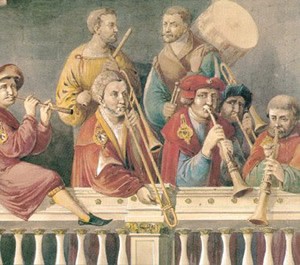
Giovanni Cellini(1451-1527) was a member of the Florentine pifferi for 34 years. (Pifferi were players of wind instruments, typically shawms accompanied by bagpipes, slide trumpets or, later, by trombones; they were employed by cities and courts during the middle ages and the Renaissance. Shawms are very loud double-reed instruments, originally introduced to Europe from the Middle East during the Crusades, a sort of hyper-aggressive ancestor to the oboe.)
Pifferi - a Renaissance wind band
Many of his son Benvenuto's biographers describe Giovanni as an engineer, or a craftsman, perhaps believing that because he worked in these trades as well and his musical responsibilities were not always full-time, music was a peripheral part of his professional life. I believe, rather, that being a professional performer was Giovanni's main employment, although it is certainly true that he, like his brilliant son, was multifaceted and took part in other activities, many of them artistic.
Most of the information to follow is derived from an article about Giovanni written by musicologist Timothy McGee, augmented by the article about Benvenuto in the Dizionario Biografico degli Italiani, an enormously useful work that is now available online.
Let's take a quick look at Giovanni's personal life: he married Elisabetta Granacci, a match described in Benvenuto's autobiography as for love only, as she had no dowry. In order to make that marriage, Giovanni sought a position in the Florentine pifferi because he needed steady employment. This would have been, then, in about 1480. The couple was not blessed with children for eighteen years, but they did finally have at least two sons (of which Benvenuto was apparently the second-born) and a daughter. Giovanni appears to have lived in Florence all his life.
And his professional activities outside of music? He was said to be a very skillful worker of ivory, and he made musical instruments: an organ with wooden pipes, harpsichords, lutes, and harps. His artistic talent must have been recognized by his fellow Florentines, because in 1504 he was one of eleven citizens - including the civic herald and several artists: Andrea della Robbia, three goldsmiths, an embroiderer, and Giovanni - chosen to form a committee to decide on the placement of Michelangelo's statue David.
As an engineer, he made machines for lowering bridges and other mechanical devices. He is also said to have constructed the scaffolding that Leonardo da Vinci used to paint his lost Battle of Anghiari on the walls of the Sala del Consiglio in Florence's Palazzo Vecchio - a work that art historians are currently searching for, very carefully, under a later work by Giorgio Vasari, in case Leonardo's work may have somehow survived.
A sketch for Leonardo's lost painting
But it is as a musician that Giovanni interests us most. As a member of the exclusive group of musicians supported by the city of Florence, he had certain well-defined responsibilities and with them came certain perks. It is clear both from Benvenuto's writings and from city documents that Florence's pifferi were men of considerable talent and ability. In addition to learning and performing written polyphonic music (at a time when not every performing musician could actually read music), much of what they played involved considerable improvisation. They needed enough memory to store a lot of repertoire, a thorough knowledge of the rules of discant for purposes of improvising, and the flexibility to play more than one instrument, for the pifferi would, as needed, shift to softer, indoor instruments such as flutes and recorders. Giovanni, then, played different woodwind instruments; he also played bowed strings and probably lute, harp, and keyboard, which, while not rare at that time, may have been less typical. And Benvenuto tells us that Giovanni taught him to play the cornetto, the shawm, and the recorder, as well as to sing and to compose.
Florence's pifferi played public concerts. They played for the members of the ruling body, the signoria, as they dined. They probably, from time to time, performed the function of signalmen, and accompanied armies into battle - a shawm's voice will carry a long way, over lots of competing sound. They may have shared with the trumpeters responsibility for fanfares, for jousts and public occasions. And when they were not busy doing those things, they were free to work at other professions or to take private musical jobs, such as weddings or processions put on by confraternities or other organizations.
Shawm players at a wedding
Their rewards were considerable, so much so that at certain points in his career, Giovanni served without salary, accepting benefits alone. (The number of pifferi was established by law, and one couldn't be added until one resigned, so sometimes players served gratis as an extra so they would be established as next in line for a vacant position.) Twice a year, the players' uniforms were replaced (at Christmas and at the feast of St. John); they were free to collect extra fees when they accepted private jobs; they and their families could eat at the table of the signoria on the days that they performed for those meals; they received a housing allowance; and if they stayed with the ensemble long enough, they qualified for a pension for the rest of their lives.
Giovanni's career was interrupted from time to time. He was dismissed from the ensemble in 1491, according to Benvenuto by the request of Lorenzo de' Medici and his son Piero, who supposedly wanted Giovanni to devote his time to his other artistic pursuits. Unlikely as this sounds, there is a mention in the city's documents of "some private individuals" having made the request for Giovanni's removal.
Piero de' Medici
Lorenzo de' Medici
However it happened, Giovanni sat out the next few years, presumably doing other types of work, and he was reinstated (working without pay) in 1495, by which time Lorenzo had died. When Adamo d'Adamo resigned in 1497, Giovanni moved into the paid position (assigned, according to official records, to play the contre basso and soprano parts).
And herein is an interesting story: Giovanni was later accused of having bought the position. Two men (a German hatmaker and a Milanese cloth weaver, resident in Florence) who had allegedly witnessed the agreement testified that Giovanni had paid Adamo fifty florins to resign his post, which was against the law. We don't know the facts of the case, but the charges were eventually dismissed.
Things went along uneventfully for Giovanni then, until time for him to retire. Yet another Medici, Lorenzo's son Cardinal Giovanni de' Medici, ascended to the papacy as Pope Leo X. He's the pope known for commenting, "God has given us the papacy - now let us enjoy it!"
Pope Leo X
Part of Pope Leo's enjoyment involved music - not surprising, considering that he had probably studied music with the great composer Heinrich Isaac (who Giovanni almost certainly knew and worked with). According to Benvenuto, the pope invited Giovanni to Rome, but Giovanni refused the invitation, and as a result was dismissed from the Florentine musical ensemble. (This was the point where Benvenuto began to turn his attention to metalwork, since he now was not going to be in a position to inherit his father's post with the musicians.)
But Benvenuto tells another story elsewhere: Giovanni's dismissal was due to underhanded activity by his former student, Pierino da Volterra, who had recently received a promotion within the ensemble. Benvenuto describes a confrontation between the two men, in which Giovanni accuses Pierino of causing his (Giovanni's) problems and curses him. And so, says Benvenuto somewhat smugly, it was no surprise when soon afterwards Pierino, telling the story to friends while making some repairs on his house, fell through the floor and sustained injuries which killed him.
The public records tell yet a third story, that Giovanni did not play very well any more, and was too old for the job. (Shawm playing is fairly aerobic.) McGee points out that there may be some convergence of the stories, in that age may have been the reason that Giovanni refused to travel to Rome, which may have been considered being unable to fulfill performance requirements; he also says that perhaps Pierino was the one who told the officials that Giovanni no longer played well.
Be that as it may, however humiliating his retirement may have been, the city (calling him a "pauper") authorized the usual pension for musicians: 8 lire per month.
We do not know how Giovanni passed the remaining years of his life; Benvenuto reports that his father died of the plague in 1527 (while Benvenuto was away at Mantua).
Connections between father and son? Both of them seem to have been hotheads; both of them multifaceted; both of them artistic, musical, intelligent, and capable; both of them willing to take a legal shortcut now and again. There appears to have been a strong affection between the two.
And if you've made it this far, you deserve a reward. Here's a link to some shawm music for a Medici procession, performed by the group Piffaro (a variant spelling). It's music Giovanni may well have played.
Enjoy!
Images in this post are in the public domain, with these exceptions: the photo of the saltcellar is licensed under Creative Commons Attribution 3.0 Unported license.


.jpg)