Sunday, April 12, 2015

Our Greek Odyssey 3: Crete (Siva, Knossos, Phaistos, Aghia Triada)


This is Part 3 of what is now my four-part post about our recent trip to Greece. (Unless it turns into five parts, which is entirely possible.) If you'd like to read about Athens, see Part 1 here. If you'd like to read about Nafplio, Epidaurus, and Mycenae, see Part 2 here.

After exploring some of mainland Greece, we relocated to Crete for a week, which we spent living in a stone house in a little village called Siva. It had been the childhood home of our host, and you could see vestiges of what it had been like in an earlier time: a courtyard with an outhouse (now plumbed and containing the washing machine), a well, and a wood-fired oven. One particular treat was to be able to pick fresh oranges from the trees surrounding the house.


Siva is tiny (population 244, according to Wikipedia). It was quiet and lovely (see view above and at top), and we enjoyed staying there. It is close to Iraklion, but far enough away to have a rural feel. We enjoyed our hosts' own olive oil while we were there, especially when we learned that we had driven past the trees that produced the olives, and the press that pressed them was just down the street. It doesn't get much more local than that.

Another example of local products can be seen in this sign, just across the street from "our" house (and next door to the goat):


We didn't try this particular vintage, but we're sure it's a winner.

Siva was far too small to boast any public transportation, so we rented a little Fiat Panda from the efficient and capable Dimitris. With it, we acquired a GPS with the usual cultured female voice, courteously instructing us on where we should be going. Since we are perhaps not the very best at following instructions, we named her Cassandra, after another long-suffering woman who nobody ever listened to.

Cassandra: "Go that way!"
 We started off elegantly enough, greeting her with "Speak to us, o Cassandra, of the road to Iraklion" and suchlike. But it fairly quickly devolved into something closer to "Bug off, Cassie, we're stopping for lunch." I don't think we are GPS sorts of people. We finally figured out how to turn her off, though for a while we had her speaking in Greek, which was almost as good.

Knossos


The famed palace of Knossos was our first sightseeing stop on Crete. Knossos, of course, is said to be the palace of the legendary King Minos and home to the Minotaur, complete with labyrinth, bull-leaping, Theseus, Ariadne, and all of that.


Knossos has seen more restoration, some of it questionable, than the other Minoan sites we visited, but it is still an evocative site.


Here are some of the current denizens of Knossos:


And two more well-known restored frescoes from Knossos (now in the museum in Iraklion):


Having poked around the northern edge of Crete for a while, we decided to head south. We huffed and puffed across the mountains in our little Fiat (which we think was muttering "I think I can, I think I can, I think I can..." in Greek) and found ourselves on the south coast, where it was about 10 degrees warmer.


Phaistos (Festos, Faistos)


Less restored but no less interesting than Knossos was Phaistos, for which we found a number of alternate spellings, including several on the road signs on our way to it.  From around the same time period as Knossos, Phaistos is in a magnificent location, with panoramic views in all directions.


The nearby site of Aghia Triada was similar in many ways, though it was more of a village and less centered around a huge palace than either Phaistos or Knossos.


These imposing pots (and the ones from Knossos shown above) are called pithoi (singular pithos). They are seriously big. The ones from Knossos probably stand 8 or 9 feet high. We should have put a person in the picture to show the scale, but we didn't think of that until after we had left. Even today the Cretans like to decorate with them, as you can see in this picture of the house in Siva:


We did see one post-Minoan site in our meanderings. Gortyn afforded us the chance to look at Roman Crete.


It also has the Gortyn Code, or at least most of it. This law code, carved in stone in lines that reverse direction (left to right, right to left, etc.), is said to be the oldest and most complete surviving code of ancient Greek law. You'll have to look carefully to see the writing, but it is there.


Next time, we go back north and head west (with occasional help from Cassandra), to show you Rethymnon, and then east, to show you Malia.

Images in this post are either our own photos, or in the public domain.


Wednesday, April 8, 2015

Our Greek Odyssey 2: Nafplio, Epidaurus,Tiryns, Mycenae


This post concerns the second phase of our recent trip to Greece. Anyone who missed the bit on Athens can find it here.

We picked the lovely seaside town of Nafplio both for its undeniable charm and for its proximity to two of the archaeological sites we most wanted to see: Epidaurus and Mycenae.


We chose the Hotel Byron, and we were not disappointed. It did require a bit of climbing, though, which we were unaware of when we trundled our luggage from the station and walked till we spotted its welcoming sign:


Around the corner from the welcoming sign was the way in (or perhaps I should say the way up):


Factor in another three flights of stairs inside to reach our room, and I think it's fair to say that we walked off the amazing homemade marmalade we ate each morning. Tim suggested that they needed a funicular, and he was heard to quote Douglas Adams from time to time concerning "the advantages 'up' has to offer." But then, he was the one schlepping the bags.

Just across from us was the church of Saint Spyridon, on the steps of which, in 1831, Ioannis Kapodistrias, the first head of state of the then newly liberated Greece, was assassinated:

Murder of Ioannis Kapodistrias, by Charalambos Pachis

A few pictures to give you an idea of Nafplio's appeal:


We rented a car to go to Epidaurus when we learned that the bus schedules were not going to allow us enough time to see it properly. Both of us had wanted to see the ancient theatre there, with its famous acoustics, and it was worth braving Greek traffic and roadsigns to get there. A person standing in the center of the stage can drop a small object and its impact will be heard throughout the theatre.


Tiryns was another archaological site we wanted to see. Called "mighty walled Tiryns" by Homer, it was said by some to be the birthplace of Heracles. Even today the huge stones of Tiryns are impressive:


And finally we made it to Mycenae, home to the great king Agamemnon of Homeric fame. It was the source of this famous mask, called the Mask of Agamemnon (though it actually is several centuries too early to be him):


If I had been Agamemnon and I had a palace with the breathtaking view he had in Mycenae, I would have left Troy to its own devices and spent my days sitting on the patio drinking ouzo. Well, okay, maybe not ouzo. But drinking in the view, definitely.


I was excited to see the famous Lions Gate at Mycenae (see picture at top, also detail below).


Very nearby, we were able to see the extraordinary tholos tomb variously known as the Treasure of Atreus or the Tomb of Agamemnon.


Inside the tholos tomb the acoustics are downright alarming. If someone speaks, a listener may well hear the sound from another place altogether. At one point I would swear I heard someone laughing demonically just behind me, but when I turned to see who was there, there was nobody at all. It was actually pretty creepy. I left with alacrity.

Here's the entrance to that tomb:


I loved Mycenae. I flirted briefly with the idea of writing about it, but then my better judgment prevailed, and I decided to leave it to the experts. (All I came up with was a limerick, and I'll spare you that.) One of those experts, my friend Judith Starkston, has written a very fine book, Hand of Fire, about the life of Briseis, a character mentioned only briefly in Homer's Iliad. Agamemnon plays a major part in her tale.

Next time, we'll be in Zorba country - Crete! Join me then for more pictures, to meet the kitty who photobombed Malia, and to find out why we named our GPS after the prophetess Cassandra.

Pictures of the mask of Agamemnon and of the murder of Kapodistrias are in the public domain; other pictures are our own.

Sunday, April 5, 2015

Our Greek Odyssey I: Athens


I was supposed to begin this blog with a picture of the Parthenon. I mean, isn't that what every spiel about a trip to Greece is supposed to start with? Classic, timeless, tasteful, sublime... 

However, as some of you may have noticed, I haven't been blogging lately, and in fact haven't been online much or communicating much. So please bear with me as I gently ease my way back into social media's comfy little illusion that we all actually have something to say. This could possibly mean that I'll be even more eccentric than usual for a while.

To make it easier on all of us, I'm going to blog my recent trip to Greece mostly with images, mostly pictures taken by my husband, but a few supplementary shots taken from Wikimedia Commons. And I'm going to divide the trip into three posts, for the three places we used as home base during our travels: Athens, Nafplio, and Crete.  (Also possibly a brief post about the British Museum in London, where we went to see all of the Greek antiquities that wound up there. To paraphrase what Hayakawa once said about the Panama Canal, they stole them fair and square.)

This one's Athens. So here's that Parthenon:


We stayed at the lovely Hotel Hermes, which had a mind-boggling breakfast buffet. You could get eggs, bacon, baked beans, pastries, baklava, spinach pie, yogurt, honey, jam, bread, toast, olives, Greek salad, tiramisu, rice pudding, bran flakes, several different fruit juices, fresh sliced oranges, apples, cheese, sliced meats, granola, and I'm probably forgetting a bunch of things. You could not, however, get this peculiar Greek gelato:


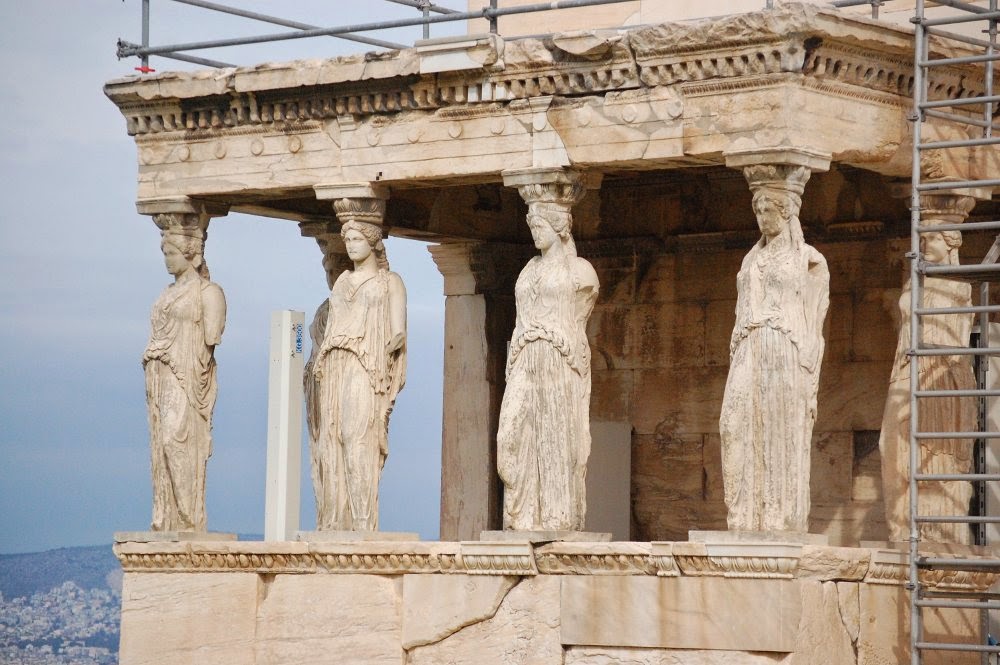
That was someplace else. But Hotel Hermes was a good base for seeing the Acropolis and the museums, and we took full advantage of it. Here's some of the evidence:


The new Acropolis Museum is spectacular, and has very pointedly left some obvious places to display the Elgin Marbles (see upcoming post), should the British by any chance ever decide to give them back.

The Archaeological Museum was amazing.


Large parts of it are currently closed due to the Greek financial crisis, but a kindly guard took pity on us when I looked crestfallen at not getting into the room with the Cycladic art, and he took us in for a precious five minutes of looking at the things I had most wanted to see. We owe him.

Athens seems to be populated by a very large number of lethargic dogs, which people just walk around, or step over. They flop down wherever they happen to be. The ones in this picture are actually atypically perky.


 After our brief private tour of the Cycladic art in the Archaeological Museum, we went to the Cycladic Art Museum for more. I am very attracted to these boldly simple ancient sculptures which have influenced so many twentieth-century artists.

Note the pointed feet on this statuette:

I've read that this type of feet indicates that the statuettes were intended to be lying down, not standing up. Though I do wonder what future generations might say about these:


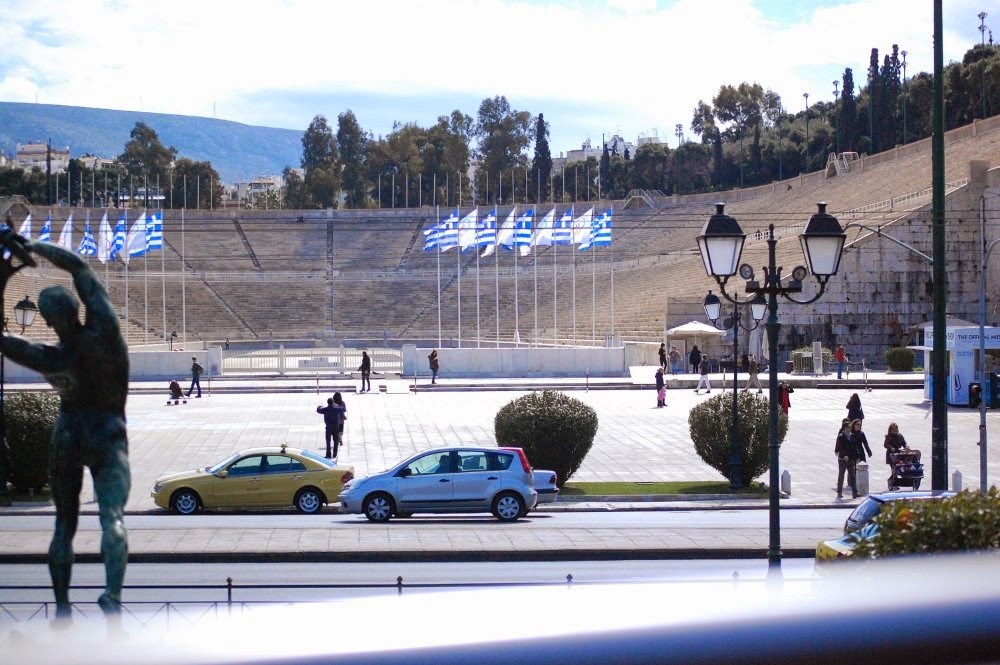
Other Athens pictures include picturesque corners, the Olympic Stadium, and the goddess herself:


We were able to watch the Changing of the Guards, which was quite an elaborate spectacle (and which we are pretty sure was John Cleese's inspiration for the Ministry of Silly Walks):


Each of those little white pleated skirts has 400 pleats, which the wearer has to iron in himself, or so we've been told. And we've also heard that they used to hide knives in those fluffy, harmless-looking tassels on their shoes.

Although this is only a taste of what this fascinating city has to offer, for now we will say goodnight to Athens and, in the next post, move on to the town of Napflio, the perfect jumping-off point for Epidaurus and Mycenae.


Images in this post are our own, except for the photo of the dolls, which is licensed to GeekChickLoLo via the Creative Commons Attribution-Share Alike 3.0 Unported license, and can be viewed here.


Tuesday, December 9, 2014

Medieval Italian insults


Angry words.  Words intended to give offense, to hurt.  To damage, whether feelings or reputation.  We have no shortage of angry words in the world today, but I've recently run across a few things in the course of my research that set me to wondering if it has ever been any different.

Before there was Twitter, before there were flame wars and trolls, before today's toxic and polarized political climate, there was the lively, colorful Italian street (not to mention the Italian toxic and polarized political climate).  Let me share with you a partial list of insults recorded in the town of Savona, Italy, for just one year in the 14th century -- these being the insults that were prosecuted in a court of law, as tallied in Trevor Dean's book Crime and Justice in Late Medieval Italy.

  • Filthy worm-head.
  • You're lying in your throat, filthy, rotten woman.
  • I hate you.
  • Go on, rotten prattler. God give you ill-fortune. [Allegation of a conspicuous lack of personal hygiene, phrased bluntly], why do you come round here with your prattle?
  • Go on, go and talk to your mates, the whores. You shouldn't be talking to good women.
  • Ugly, rotten pimp.
  • You're a devil and a piece of filth.
  • Thief and rogue.
  • Mad boy.
  • Witch-whore.
  • Ugly, shameful woman, you take men [crude description of a non-procreative sexual practice]
  • Go and get f***ed.
  • Rotten pimp, we shall chase you from your house.
  • Rotten dog whore.
  • Rotten donkey, ribald.
  • Ugly, rotten whore.

Some involved threats, explicit or implicit, but those were not necessarily weighted more heavily in the courts than the ones that didn't:

  • I hate you like a dog. I shall punch and kick you.
  • By Christ's body, I shall have to hit you on the head. (This one manages to involve blasphemy as well; it was a separate crime.)
  • Rotten pimp, we shall chase you from your house.
  • I want to see you dragged through this town. 

The commonest were “I hate you” and “You're lying in your throat.” (Tu menti per la gola.)  That last one intrigues me, partly because I came across it in connection with researching my novel A Thing Done, and the phrase does appear in my book much as it does in the historical record.  Why, I wonder, is it worse to lie in one's throat than just to lie?  I haven't found an answer to that, but it does seem to me that while one could lie easily, glibly with one's mouth, to lie in one's throat suggests a deeper well of malice.


Dean points out that the Savona insults can be roughly divided into three categories:  sex, defecation, and rottenness.  In other towns, such practices as cursing someone with a disease were prevalent.  “Get dog-worm!” appears to have been something of a favorite.

In Todi and Bologna, gender differences showed up clearly: threat of injury, challenges, and imprecations of ill-fortune were made only by men and usually against other men. Women could only wish on men the inflection of violence by other men (like the “I want to see you dragged” remark, above).  Women were insulted via their sexuality or sexual decency, and men through their public roles or their “honesty, courage, and worth.”


Other cities, too, give us some colorful examples.  In Florence, on18 June 1375, the podestà accused  Filippa, daughter of Matteo, in the parish of Sant'Ambrogio, of having slandered Piero di Cianchino, who lived in the nearby parish of San Simone. She called him “filth, traitor, thief.” Piero said, “If you were a man instead of a woman, you would not be able to say these words to me.” Filippa, undeterred, told him “I am a woman, and I will shame you all the same.”  (The records do not show what Piero had done to provoke Filippa's ire.)  But Filippa, who had an interesting worldview, wasn't done yet. She went on:

“What a feast God and the mother who brought you into this world would have, had they given me the heart to have more men to kill than you could have over to dinner.”

Without explanation, the podestà's court cleared Filippa of all charges.  Perhaps he just didn't want to be next.

Filippa, perhaps?

And in Palermo, 1328, here's the Master of the Guard speaking to a nobleman.

“You're lying in your throat like a rotten, evil, ruffian, cuckold and traitor. Sir S**t. Cripple-legs. Mouth-stinking bastard. You're no knight....”  Then, just for good measure, he called the man's wife a “rotten bitch-harlot.”

Incidentally, I wonder if the frequency with which we see the word “rotten” appear has something to do with “mouth-stinking,” as above.  Rotten teeth mean bad breath, and I wouldn't be surprised if that is the source of that particular insult, given the state of medieval dentistry.


Each city had its own way of prosecuting what we might think of as “crimes of insult.”  In Chiusi, for example, miscreants were fined by the insulting word. But how to count them?

We can study the case of Niccolò, who said to a married woman, “Dirty, deformed woman, provocative whore, I've had three children by you, you dirty, sick beggar. Your mother went begging and gave birth to children in the stables.”  There would seem to be a certain behavioral inconsistency here, but Niccolò seems unaware of it.

Then, as if that wasn't enough to make his point, he turned to her brother.  “Your sister's a whore, and her daughter. May your soul be accursed and your father's, may there be as many devils after his soul as he had dogs following him.” Over 60 words (none of them exactly friendly), but the authorities counted the diatribe as 8 insulting “words.” Six of the counted categories were bodily deformity, prostitution, disease, beggary, shameful parturition, and cursing the soul.”  The record is unclear about the others.

Modena criminalized only “cuckold” and “lying in one's throat”, or taunting someone with the killing of his male kinsman (as yet unavenged, presumably).

Cesena charged 10 lire for “traitor, false cuckold, pimp, robber, thief, goat, ribald, heretic, sodomite, whore, and pimp.”  “Get dog-worm” and “Go hang yourself” were considered everyday and therefore unimportant.

"Goat"?

In Fabriano we see a bit of class consciousness evoked with this insult:  “You've eaten farro soup.”  (Meaning: You've eaten coarse peasant food, so what does that make you?)

And speaking of class, it was not unusual for people to be fined more for insulting someone of higher status.

A historical example of an insult from Florence:  messer Corso Donati called his nemesis messer Vieri de Cerchi “the ass of Porta San Piero” “because he was a very good-looking man, but not very astute or articulate,” chronicler Dino Compagni tells us.  Corso frequently asked “Has the ass of Porta San Piero brayed yet today?”  And just to amplify the insult, he employed a jester named Scampolino to spread his words around as widely as possible.

And then there are the literary examples.  Franco Sacchetti, fourteenth century Florentine writer of short stories, favored “Get dog-worm!”  In his tales it was said by a lord to his buffoons, a peasant to a wolf, a husband to a wife, and a nobleman to his servant.

Boccaccio

Giovanni Boccaccio, another Florentine and author of The Decameron, tells a tale of friendly insults between friends.  Messer Forese da Rabatta and the famous artist maestro Giotto di Bondone were riding together one day when they were caught in a rainstorm, which left both of them bedraggled. Forese, according to Boccaccio, hadn't looked too good to begin with: he was small, with a deformed body and a flat, pushed-in face, yet he was a wise and learned jurist. Giotto was an artist of great genius, but he may not have been a great beauty either.  There's a story of Giotto and Dante in which Dante asks Giotto how it is that the painter's work is so beautiful, but his children are so ugly, and Giotto supposedly replied, “I make my paintings during the day and my children at night.”


Be that as it may, after the rainstorm neither one was looking very good.  Forese said, “Giotto, what if we were to run into a stranger who had never seen you before, do you think he would believe you were the best painter in the world, as you really are?” And Giotto replied, “Sir, I think he would believe it if, after looking you over, he were to think you knew your ABCs!”

Dante's remark to Giotto (above) was far from his only foray into the colorful world of insults.  He engaged in a tenzone (a poetic exchange of insults) with Forese Donati, his friend (and the brother of Corso Donati, above), which some scholars still prefer not to believe could actually have been authored by the great poet.  In the exchange, the two poets accuse each other of sexual inadequacy, beggary, gluttony, thievery, and cowardice, not to mention hinting at even more scurrilous things.

Dante was not above the classic “insult the other guy's mother” ploy, either.  Forese's and Corso's mother, monna Tessa, must have been a redoubtable woman (see my blog post on her here), but Dante didn't hesitate to slam her in verse:
O Bicci junior, son of who knows who
(unless we ask monna Tessa)...
(“Bicci” was Forese's nickname.)

And he didn't let it rest there.  Later in the same poem, he writes of Simone Donati, Forese's and Corso's father:
...who is to you what Joseph was to Christ.
Hmm.

Dante encounters Forese in Purgatory

That's not the only surviving account of someone insulting Tessa.  The Lucchese writer Giovanni Sercambi, 1348-1424, wrote a collection of 155 short stories, one of which told a tale of monna Tessa.
 
For the details, please see my earlier blog post here, but the gist of it is this:  a man called Bisticcio called out to her the medieval equivalent of “Hey, Babe, how about it?” 

And Tessa calmly responded with the medieval equivalent of “Forget it.  You can't afford me.”

A good note to end on.  I hope you've enjoyed this little tour of insults in medieval Italy.

Images in this post are in the public domain, with the exception of the photo of Giotto's statue, which is licensed to Sailko via the Creative Commons Attribution-Share Alike 3.0 Unported license.