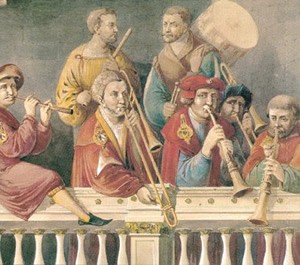
Monday, August 27, 2012

Lowde Mynstralcyes


Lowde mynstralcyes, indeed.  That's what Chaucer calls a huge gathering of minstrels and jongleurs he wrote about in his work House of Fame.  He describes it as a dream sequence, but some musicologists believe that he must have been a witness to one of the annual Lenten minstrel schools that took place in Europe throughout the 14th century and a bit beyond (and which some say began as early as the 12th century). 

I want to tell you something about these gatherings.  It's an arresting thought:  minstrels, particularly instrumentalists, coming together from many countries to share repertoire, learn new techniques, trade or purchase instruments, recruit new players, and form personal connections, all at the expense of the lords or municipalities who employed them, and who wanted their musicians to be au courant for the honor, prestige, and pleasure of their masters at home.

I want to and I will, but I'm late in posting this, and time is at a premium for me just now.   So let me just - for now - share with you a bit of personal history that probably explains why the idea of such international musical gatherings so intrigues me.  In a week or so, as time permits, I'll write that blog post; meanwhile, consider this the preamble.

I have some idea of what this extraordinary week-long experience might have felt like to the musicians.  For years, my husband and I attended a week-long medieval music workshop every summer.  We brought along our shawms, crumhorns, and recorders.  We traveled halfway across the continent to get there, and it was a major investment of time and money.

Once there, we found friends from far-flung places, people we never saw at any other time, and greeted them happily.  We plunged into a frenzy of intense musical activity, forming classes and performing groups according to our most immediate needs and interests.  We pushed ourselves, not wanting to miss a moment.

Trying to do it all

All of us ate together, slept in spartan dormitory rooms, and lived and breathed music from the moment we awakened to when we finally collapsed, late at night.  We learned, experimented, performed, clowned around, partied, and shared experiences.

It must have been very much the same for the minstrels.

Was it intense for them too?  I should think so.  Was it exhausting?  It must have been, especially on top of all the rigors of travel in the 14th century.

Tired musicians

Was it exhilarating?  I'll bet it was.

One thing we found at our workshop was the phenomenon of the Wednesday Meltdown.  That was the point, midweek, when we had all crammed our heads so full of new information and experiences that we suddenly couldn't remember which end was up.

That fingering?  I dunno - am I trying to play a D soprano shawm with the same fingerings I used yesterday for a G alto recorder?  What's the chance that it might actually work?

Are we transposing?  Which line is that C-clef on, and what does that mean if I'm on the bass line?  If we're reading period notation, how do I know how many units of perfection there are if I don't know whether that's a dot of augmentation or a dot of division?

Are all of us in the same hexachord here?  And if we aren't, who's going to do what with the ficta to make the cadence work?  If we're improvising, can I play a 6th above the tenor here or not, if it's 3-part discant?

This is the point where you believe in all sincerity that you've forgotten everything you ever knew, including your name.  In the end, you just pick up an instrument and honk on it until something works.


Oddly enough, I've seen people drop out of classes they think are too demanding, but only on Monday or Tuesday.  I've never seen somebody give up on a Wednesday.  I think by that time we're all so deeply involved in what we're doing that it simply doesn't occur to us.

Ah, but Thursday...  Thursday is different.  We wake in the morning, and somehow something has shifted.  We know what we're doing again.  In fact, it's really not so hard, after all.  And I've got some new ideas I want to try...

Then at the end of the day, after listening to strains of Machaut, Dunstable, and Landini issuing from the classrooms, we gather on the porch at night, relaxing and sharing a bottle of wine (okay, several bottles of wine), and singing what must sound to an outsider like Beatles tunes, of all things.  Until the listener realizes that the words are something like, "Machaut, ma beau, these are words that well together go, ma Machaut..."

Was it like that for the minstrels?  I'd like to think it was.  (Possibly minus the Beatles songs.)  Check back for the post that's the Real Thing, where we delve into this phenomenon in detail.

Thursday, August 16, 2012

Comic Opera, or Medieval Tabloid Fodder?

Scene from Gianni Schicchi

 Both, actually.

Opera fans know Gianni Schicchi as a one-act comic opera by Giacomo Puccini, written in 1917-18 and with a libretto by Giovacchino Forzano (an Italian dramatist whose later association with Benito Mussolini and the fascist regime irreparably damaged his career and reputation).

Giacomo Puccini

 Operas are notorious for ending with one or more dead characters, but this charming little work begins with one.  It's set in Florence in the year 1299, and it tells the story of how Gianni Schicchi, a clever man with a gift for mimicry, successfully impersonated the just-deceased Buoso Donati in order to dictate a will that left the deceased's estate to his family.  Buoso's family had recruited Gianni to help them out because Buoso's actual will gave most of his money to the church - not an unusual thing to do when someone reached the end of his life believing that he had practiced usury, and thus had to make amends for the sake of his soul.

In the course of enriching Buoso's family, Gianni managed to enrich himself quite a bit as well, leaving money and possessions to himself (while disguised as a dying Buoso).  Buoso's relatives could hardly object without giving away their own part in the deception, so the mimic and those who employed him all profited, with only the church losing out.

The opera also adds a love story between Gianni's daughter Lauretta, who is in need of a dowry, and Rinuccio, a relative of Buoso's, whose family opposes the match.

Florence Easton as Lauretta, December 1918

 Hijinks ensue, including hiding Buoso's body and putting Gianni Schicchi in the dead man's bed and clothes, the better to fool the notary.  Various members of the Donati family take turns secretly proffering bribes to Gianni, each wanting a larger cut of the inheritance.  Naturally Gianni outsmarts them all, pulls off his performance brilliantly, provides his daughter with a generous dowry, courtesy of the late Buoso, and they all live happily ever after.

I've known this opera for years, and I'm embarrassed to say how long it took me to realize that it was talking about real people and - very likely - a real incident, or at least a very venerable and persistent urban legend.

I know a little something about the Donati family around that time.  They've been a focus for my research for years:  Gemma Donati, who married Dante, and her tempestuous cousin Corso, a knight and a leader of the Guelf party, who came alarmingly close to becoming the Signore of Florence.

The Donati were numerous, their clan consisting of lots of different branches.  They were old nobility in Florence in Dante's time.  The contemporary chronicler Dino Compagni (see recent post) said of the Donati, comparing them to the nouveau riche
Cerchi clan, that they were "of more ancient lineage, but not so rich."

So - where else, besides an early 20th century opera, can we find this story?


It all goes back to Dante.  (In this blog, it usually does.)  Dante placed Gianni Schicchi in the Inferno, Canto XXX, the Circle of the Impersonators.  There the wretched Gianni has been driven mad with rage, and he "ran biting in the manner of the pig when the sty is opened."  (Translation by Robert M. Durling.)

Gianni Schicchi in hell
As Dante watches, Gianni sinks his teeth into Capocchio, another damned soul, whose body was burned at the stake in Siena in 1293 for his alchemical pursuits, which is how he finds himself among the falsifiers in Dante's hell.

One suspects Dante may not have appreciated the humor in Gianni's escapade.  All Dante tells us of Gianni Schicchi is that he acquired "the queen of the herd" by posing as Buoso Donati and dictating a will.

We know the Gianni Schicchi story, as it turns out, from several early commentators on Dante's Divine Comedy.  They tell us that Gianni Schicchi and Simone Donati (Buoso's son, or in other versions his nephew) conspired to commit their fraud, that Simone hid Buoso's body, and that Gianni willed himself Buoso's prize mare (some say she-mule).

The chronicle the opera libretto is based on was written around 1400 by a person known as Anonimo Fiorentino.  His chronicle stood out among others for the wealth of historical background he provided about the persons and events Dante wrote of.

A page from Anonimo Fiorentino's commentary on Dante's Commedia
Digression alert:  Some of you know that I enjoy employing automatic translation from time to time, amusing myself with the garbled results.  It is said that the Anonimo Fiorentino was not particularly strong in literary analysis, but someone writing about him apparently was, to judge from this automatically-translated quote:

"...but well clear, even to a hasty reader of ancient exegetical tradition as long as practical, the character of its own cento undoubtedly the work, although the definition, because the methods of commentary and the usual technical compilatoria of the middle, does not imply a priori a value judgment."  Very - um - professorial, I'm sure.

End digression, and back to our friend Anonimo.

Anonimo tells us that Gianni Schicchi was from the Calvalcanti family.  Although the opera libretto suggests that the Donati considered Gianni to be their social inferior, the Cavalcanti were a wealthy and distinguished family, including knights.  Guido Cavalcanti, Dante's "first friend,"  poet and intellectual, was the son of a knight, and certainly he moved in the highest social and political circles of Florence in the latter part of the thirteenth century.

Gianni Schicchi's partner in plotting was Simone Donati, says Anonimo, who calls Simone Buoso's son.  (We will, in a moment, attempt to figure out exactly who Simone and Buoso were, historically.)

We learn from Anonimo that Gianni Schicchi, imitating the late Buoso's voice, dictated to the notary a will in which he left to his dear friend Gianni Schicchi his valuable mule, as well as 500 florins.  Simone attempted to demur, but Gianni was having none of it, and Simone "kept silent out of fear."

So.  Who was this Simone?  Some say it was Corso's father (remember Corso?), a knight, a prominent Guelf, and a man who had served as capitano or podesta in several other cities, a mark of considerable distinction.  That Simone died in the mid-1290s, which would rule out the opera's purported date of 1299.  (Not that one expects much historical accuracy from operas.)  But almost every generation of Donati ever recorded has at least one Simone, and there are also at least three Buosos in two different generations in the thirteenth century.

Since historians claim that Gianni Schicchi was dead by 1282, that pushes our date back even further.  The opera, by the way, states Simone's age as 70, and calls him Buoso's cousin.  The historical Simone-Corso's-father was probably at the very least in his mid-twenties when Corso was born in about 1250.  If we posit that he was born in, say, 1225, and that the incident took place in, say, 1280, he would have been only 55.  (However, had he lived until 1299, he would indeed have been close to 70.)  But hey, it's an opera.  Let's get back to the historical record.

What about Buoso?  There was a Buoso Donati mentioned in a document in 1213; he had no sons.  In the next generation we find two Buosos:  one was Buoso son of Ubertino, who lived at least until 1308; the other was his cousin Buoso son of Vinciguerra, who died in about 1280.  The latter was married to one Adalina.

Kathleen Howard playing Zita, one of Buoso's relatives (1918)
To complicate matters, in the next generation we find Buoso son of Forese, Forese also being the father of Simone-Corso's-father.  (The Donati had a lot of Foreses, too.)  This Buoso was the father of Gasdia and Taddeo.

None of our Buosos has a son named Simone.  How about a nephew?

Why, yes.  Buoso son of Vinciguerra is brother to Forese, who is father to Simone-Corso's-father.  Thus, Simone is that Buoso's nephew.  And that Buoso died in 1280, so he has my vote.

Yet another reason to disbelieve the opera on the date, by the way, is that the Cavalcanti and Donati families were on opposite sides of the political fence by 1299, siding with the White and the Black Guelfs respectively.  Not so back in 1280.

I should note that some historians believe it was Simone's brother Buoso, the father of Gasdia and Taddeo, who died, and Taddeo who conspired with Gianni.

But I think the best case is this:  Buoso di Vinciguerra died in 1280, and his nephew Simone-Corso's-father perpetrated the fraud with the help of Gianni Schicchi, a member of the Cavalcanti family.  Simone would have been at least 55, and his son Corso (who by then was married to a member of the Cerchi family - remember the Cerchi?) was 30 or thereabouts.

What did Dante know, personally, of Simone?  Dante would have known that Simone gave his daughter in marriage to a political foe as part of a peacemaking initiative (it didn't work out very well; the peace didn't last, and Simone's son-in-law was executed); that he was warned by city officials against troublemaking and inconveniencing a parish church on at least one occasion; and that he was said to have forced a young girl to accede to his desires by accusing her father (probably falsely) of horse theft, imprisoning him, and putting him to the torture. All of these things happened before 1280.

And yet, Simone also played a major role in peace negotiations with Cardinal Latino, the papal legate, in 1279-80.  He was known as a skillful warrior and orator, he went on various missions as an ambassador, and he was knighted by the Guelf party for his leadership.  A complex man, Simone had suffered exile for a period in the 1260s, following the Ghibelline victory at the battle of Montaperti, and lost (with his brothers) a great deal of property:  two towers and houses in the parish of Santa Maria Alberghi, and in a nearby rural area another tower, two palaces, and two mills, at a total value of 2200 lire.  

We should bear in mind that these men - Simone and Gianni Schicchi - were almost certainly men Dante knew personally, from his neighborhood, his church, and his political party.  Florence, a major city at that time, was a mid-size town by modern standards, probably approaching a population of 100,000, and most people in the noble or knightly class did know each other.  If Dante believed this tale of Simone and Gianni, there may well have been something to it.  Certainly many other people back then knew the story.

I don't know if this background makes the opera any more enjoyable for you; it does for me.  Here is a clip of a short excerpt:  Gianni is singing to the assembled Donati family, warning them that they dare not expose him because by so doing they would expose themselves to the penalty for fraud:  exile ("like a Ghibelline") and the loss of a hand. 

http://www.youtube.com/watch?v=gOJnIVd9jcc

Images in this post are in the public domain.

Wednesday, August 8, 2012

They really knew how to make a guy feel welcome

Giostra del Saracino, Via Larga, Firenze

Recently, while researching another topic entirely, I found a description of a fifteenth-century Florentine party that absolutely boggled my mind, and I couldn't resist sharing it here.

I was doing some reading about late medieval wind bands, and I picked up a book by musicologist and music historian Timothy McGee, called The Ceremonial Musicians of Late Medieval Florence.  In the course of describing some of the elaborate ceremonies with which the Florentines marked special occasions - religious holidays, celebrations of military victories, knightings, investiture of officers, visits by foreign dignitaries, and so forth -  he gave us a detailed description of two overlapping visits in 1459 that illustrates the lengths to which fifteenth-century Florentines would go to do honor to their guests (and by so doing, bring honor to their city).

The first visitor:  the young Count Galeazzo Maria Sforza, fifteen-year-old son of Duke Francesco I of Milan, sent to Florence to meet Cosimo de' Medici and help cement the alliance between the two cities.  Young Galeazzo was also to have the opportunity to meet the second visitor, Pope Pius II (Aeneas Silvius Piccolomini), who was to stop at Florence on his way to Mantua for a church council. 

Here are Florence's two honored guests, that spring of 1459 (though the portrait of Galeazzo Maria was painted about twelve years later than the visit:

Portrait of Galeazzo Maria Sforza by Piero Pollaiolo, ca. 1471

Pope Pius II

And what do we know about these two distinguished gentlemen?

The Pope is described (elsewhere, not by McGee) as intellectually gifted and ambitious, a man of letters (with poetry, a comedy, and a slightly naughty novella entitled The tale of two lovers to his credit, as well as the surprisingly frank memoirs of his papacy), a womanizer, a skillful and pragmatic political strategist, and a talented town planner who turned the village of his birth (Corsignano) into the exquisitely-designed Renaissance city of Pienza.

And Galeazzo?  He does not fare so well, at least in his later years.  Wikipedia tells us that he was famous for being lustful, cruel and tyrannical, and he was eventually to be assassinated by a group of men with a surprisingly eclectic collection of grievances.  The year after this visit he took as his mistress the lovely Lucrezia Landriani, who was the wife of his close friend, and she bore him several children, including the redoubtable Catherina Sforza.  Besides a certain proclivity for viciousness, however, he did have a more positive side:  a lover of music, he was patron to some of the finest musicians of his day, including Alexander Agricola, Johannes Martini, Loyset Compere, and Gaspar van Weerbeke.

Lucrezia Landriani
This portrait can be found attributed variously to Domenico Veneziano and to Antonio del Pollaiuolo.  I tried to check online to see which was right, but kept turning up gems like "Lucrezia Landriani (572 years old) is a famous Duke..."  So I gave up.  Next time I get to the university art library, I'll check it out and edit this, if I remember.

Anyway, on the Florentine side, we have Cosimo de' Medici, 70 years old, holding the reins of government (albeit unofficially).  His grandson Lorenzo, later to be dubbed Il Magnifico, was at this time ten years of age and probably more precocious and cute than magnificent, but he was working on it. 

But on to The Party.  It all began when Galeazzo arrived at the gates of Florence on April 17, 1459.  He had brought a few people with him:  500 of them, in fact, including the Archbishop of Milan, the captain-general of the Milanese army, a bevy of barons, knights, counts, and other nobles, and all of the various people required to take care of, cosset, and entertain all of these important folks.

Galeazzo's party was met by a mounted delegation of over 300 distinguished Florentine citizens, as well as the Priors, the Podesta, the Capitano del Popolo, the herald, and all the civic musicians (which at this point amounted to three different groups:  the trombadori, which consisted of six large trumpets, a shawm, and nakers [small kettledrums], for fanfares and announcements; the trombetti, players of smaller trumpets which had more notes available to them and therefore more musical possibilities; and the pifferi, or shawm band, which consisted of three shawms and a slide trumpet at that time).

Wind band (this configuration is a little late for 1459)
If this suggests to you that a lot of music was to take place during this visit, that's absolutely correct.  Francesco Sforza, Galeazzo's father, had a band of 18 trumpeters, at least some of whom would have come with his son, and Cosimo de' Medici had his own household musicians and singers from the church choirs, to add to the mix.

In Florence that day the shops were closed, and people filled the streets to greet the visitor.  Among the greeting committee was a group of a hundred boys, dressed in silver with pearls.  Galeazzo's carriage was preceded by fifty mules wearing his heraldic colors, but it's not clear to me whether these mules were Florentine or Milanese.  After a lot of fanfaring and church bells ringing, the whole bunch processed to the Piazza della Signoria for the official welcoming ceremony.

The order of the procession through the streets is known to us:  first Florentine famiglia (staff - civil servants, actually), then Galeazzo's famiglia; next the trombetti; the Florentine boys and the Milanese foot soldiers; the pifferi with the civic herald; Galeazzo with the Florentine Priors; the knights from both parties; and then all the other Florentine citizens.  After much more fanfaring and some speechifying, the young Galeazzo was taken to the Medici palace, where he would stay during his visit and where, presumably, he would meet the even younger Lorenzo.

And here I will digress for a moment.  Benozzo Gozzoli, who painted the magnificent fresco of The Journey of the Magi in the Medici Palace, is said to have incorporated images of both of those young men in the panel depicting the journey of the youngest king.  Some art historians dispute these attributions, but let's have a look at the images anyway.  Here's the Young King, said to be a portrait of Lorenzo:


And here, on the white horse, is the young man said to be Galeazzo:


 Some art historians believe that the second picture actually depicts Lorenzo and his younger brother Giuliano.

The Pope was not to arrive until April 26, but there is little doubt that the Florentines kept Galeazzo well entertained in the meantime, with music, feasting, various performances, and courtly dances, such as the one pictured below (note the shawms accompanying the dancers).


When the Pope did arrive, he also brought a large contingent:  many nobles from different cities, ten cardinals, sixty bishops, and quite a few priests.  Officials of the Guelf Party met him  at a monastery outside the gates of the city and escorted him, under their banner, to the gates, where the civic leaders received him.  He was then seated on a throne covered with gold brocade and carried through the streets on a litter.  (He requested that the litter be carried by the Priors; Florence said no.  I would love to have been there for that discussion!  Instead, various princes and nobles in the Pope's party served as litterbearers, and Florence's civic dignity remained untarnished.)

The Pope's entry was treated as a religious procession, complete with relics, torches, and sacred music.  All of the important people from Galeazzo's entry were there, and Galeazzo himself followed behind the Pope's litter on horseback, and behind him came the cardinals and the other churchmen.  After the welcoming ceremony at the Piazza della Signoria and a stop for the Pope to pray in the Duomo, the procession took the Pope to Santa Maria Novella, where he was to reside in the papal apartments. 

The next day, April 26, another procession took place, from Santa Maria Novella to the Duomo, where he spoke to the people and received many valuable gifts.   And on an unspecified day soon afterwards, yet another procession occurred, this one including sacre rappresentazioni (dramatic presentations of sacred stories) and floats, an ephemeral art form in which Florence excelled, all carried on a total of 46 carts. 

By April 29, they were ready to liven things up a little.  After all, Calendimaggio, the May Day festival, was almost upon them.  So that day they held a joust in the Piazza Santa Croce, with platforms for the audience.  Tapestries hung from the windows of the surrounding buildings, and each contestant was greeted by a trumpet fanfare and preceded by pages carrying standards bearing their heraldic insignia.  All the horses (and the people) were lavishly decorated.  Antonio Boscoli and Braccio Guicciardini  took first and second place, respectively, and received decorated helmets.  All finally left the field to the music of the pifferi.

The next day, April 30, involved a massive ball, with an estimated 20,000 persons in attendance.  Held in the Mercato Nuovo, this splendid occasion included lavish costumes and decorations, an elaborate dais set up for Galeazzo and the Pope, rich carpets and cloths everywhere, another raised place for the pifferi to play the music for the dancing, All sorts of banners and twenty trumpeters who saluted the arrival of each and every lady with a fanfare.  (Galeazzo got a fanfare, too.)

On May 1, Galeazzo was invited to dine with the Priors, at a particularly lavish meal  with "every kind of splendid food and elegant wine." ( The next day the Pope was the guest of honor at the Prior's mensa, and again there would have been musical performances for their dining pleasure.)

That afternoon, the visitor was treated to a caccia, a sort of bear-baiting on steroids, in which a cordoned-off Piazza della Signora contained cows, bulls, horses, wolves, wild boar, wild dogs, a giraffe, and either twelve, sixteen, or twenty-six lions, depending upon whose account you believe.  As you can imagine, this was not a particularly pacific mix.  And in the midst of this mess was a man in a large round ball about two and a half meters high, able to propel the ball where he wanted it to go and to chase the lions and wound them through openings in the ball, while remaining safe inside.  This was described by an observer as "a beautiful, grand, and ingenious thing, never before done in Italy.  And this idea came from a Florentine who had seen it done in the countries of the Sultan and in Syria."  No comment.  (Also, unfortunately, no pictures.)

That evening, in case Galeazzo wasn't entertained enough by then, the Florentines held an armeggeria for his amusement.  (That's an equestrian exhibition, featuring stylized war games and contests.)  It was held on Via Larga, and was much like the picture at the beginning of this post.  The ten-year-old Lorenzo was the signore for the event, wearing a golden jacket and cape like the Youngest King in the Gozzoli fresco.  The armeggeria also involved a certain amount of processing, this time by torchlight, and a trionfo consisting of fifty costumed youths leading The Triumph of Love, a four-sided tower three meters tall, decorated in gold and silver, on a wagon.  It featured large gold balls with falcons, fire spewing from openings on both sides, and a youth dressed as Cupid perched atop it all.

Once everyone (except for a lot of the animals) had survived May Day, things began to wind down a little.  On May 2, Galeazzo received from Florentine officials gifts that included two silver basins decorated with the emblem of the city of Florence, two tankards, and twelve engraved cups, all of which weighed 125 pounds and was valued at 2,000 florins.  (Also two boxes of candy - he was, after all, fifteen.)

Finally, on May 3, Galeazzo headed for home.  Not that he managed to just slip quietly away, of course - his departure included ceremonies and extended processions through the city streets.  Two days later, the Pope also left to continue his journey to Mantua, and then, too, there was much pomp and circumstance.

Not too shabby, for the young count, especially.  Florence had done itself proud, and finally everyone could kick back and relax and let life get back to normal.  The stores could reopen, and people could get back to doing what they did best, even better than partying, which was making money.

***

Postlude:  Galeazzo did make another visit twelve years later, but it was during Lent and there was no Pope in evidence, so things were much quieter and calmer.  This time he brought his wife, and an entourage of over a thousand people, with 1,500 horses and mules.  Both the Duke (as he was by then) and the Duchess, Bona of Savoy, had their own extravagant households.  An eyewitness described their entry this:  "There was a livery for his greater Camerieri, all dressed in crimson, and each one well mounted on horseback, with a greyhound on a leash.  There were also sixty pages, all dressed in green velvet, on huge coursers, all with fittings of gold and silver, and saddles covered with brocade of various colors and crimson..."  There's more, but you get the gist. 


Images in this post are all in the public domain.

Saturday, July 28, 2012

Ruminations on Marquee Names

-->
Cattle die, kindred die,
Every man is mortal:
But I know one thing that never dies,
The glory of the great dead.

Hávamál, trans. W.H. Auden and P.B. Taylor

Really?

I've been thinking about the concept of fame lately, viz. who's famous and who's not. This is mostly in the context of writing historical fiction, an area in which a longstanding debate continues to simmer: must a book have what some call a “marquee name” to sell, or is that not necessary? Agents and publishers largely seem to favor having someone in your book who everyone's heard of, whether that person is the main character or not, but various surveys and informal discussions suggest that this may not be as important to readers as it is to publishing professionals.

I don't want to wade in to this particular debate, which appears to be set to continue indefinitely. But I am starting to wonder exactly what constitutes a “marquee name.” And I've concluded that one person's famous person is someone else's “Huh?”

Part of this wondering comes from my own writing experience. While I can't remember a time when I didn't know the story of the headstrong knight Buondelmonte, the jester whose prank provoked him, and the cavernous split between the Guelfs and Ghibellines that resulted, I have had to come to grips with the fact that most people have absolutely no clue who these people were.

Buondelmonte, slain
Yes, they're mentioned in every contemporary chronicle; yes, some of them are in Dante's Divine Comedy; yes, Machiavelli cites the incident in his history of Florence. But it's understandable that modern Americans would not know the tale, unless they have, as I do, a particular interest in Italian history. And heaven knows there are plenty of people others consider famous who I've never heard of. You can't be an expert in everything, no matter how many crossword puzzles you work.

And it's entirely possible that a book about, say, Betsy Ross would occasion nothing more than a shrug from an audience outside the U.S.


But I have long believed that Buondelmonte is a household name in Italy, or at least in Florence, and now I'm not so sure.

What has made me doubt? I was reading about the making of Woody Allen's latest film, To Rome With Love. It's said that Allen hated that title. He wanted Bop Decameron, which makes perfect sense to me. But apparently when they tried it out on various groups of people, including Italians, nobody got it.

Boccaccio
Okay, so maybe not so many people have actually read Boccaccio's masterpiece. I'd have to say they're really missing something, but so be it. That title wouldn't work.

So next they tried Nero Fiddled. And, believe it or not, nobody got that.

Nero
 They don't know about Nero? And his fiddle (even if it was probably a lyre)? And Rome burning? Even in Italy?

Well, then, who exactly is still famous?

If you throw in the preference many agents and publishers have for historical fiction written from a woman's point of view, you are then trying to identify the available field of women in history who an audience – an American audience, let's say – would actually know something about.

The Big Three
That, I figure, would be the Big Three. Cleopatra, Eleanor of Aquitaine, and Anne Boleyn (described by a well-known literary agent as “the poster girl of historical fiction”). Check 'em out. You won't find any shortage of books about any of these three women.

But surely people know about other famous women, you say. Well, yes, probably; these runners-up would get high marks for recognizability:

Runners-Up
They would be Queen Elizabeth I, Queen Victoria, and Marie Antoinette. Of those, Queen Victoria probably graces fewer books than the other two, but at least people know her name. After all, she and Elizabeth each had a whole age named after them. Marie Antoinette, of course, shares with Al Gore the predicament of being famous for a particularly dippy statement that she/he never actually said. (Hint: one of them advocated eating cake, and the other invented the internet.)

But I wanted to explore this idea of who's famous and who isn't, to see if I could make any sense of it. In the course of checking to see where a particular Italian was buried, I checked a fascinating site called Find a Grave. I went to the Italy version, and was interested to learn that they had two categories of well-known people interred somewhere in Italy: Very Famous, and Somewhat Famous.

(This reminds me of Miracle Max, in the movie The Princess Bride:  "It just so happens that your friend here is only MOSTLY dead.  There's a big difference between mostly dead and all dead."  I think there must be a big difference between Very Famous and Somewhat Famous, too.)

So I scanned Very Famous. I was expecting to find Dante there; how could the great poet not be Very Famous? I mean, he's so famous that people who've never read his work pretend they have. It doesn't get much more famous than that.

Dante is not there.

Boccaccio is (remember Boccaccio?). Enrico Caruso is. Luciano Pavarotti (or “Provolone,” as my former co-worker insisted on calling him) is there. Saint Francis of Assisi is there. Igor Stravinsky is there. (Yes, I know he's not Italian, but he is buried on Venice's funeral island.) And three guys who were awarded the Victoria Cross for their military heroism are there.

Very famous? Three men, no doubt heroic and in all ways laudable, but one of whom earned his award in a war I hadn't even heard of? (No, I'm not going to tell you which one that was.) More famous than Dante?

I don't think so.

So I checked out Somewhat Famous. Dante did at least make it to Somewhat Famous, I was relieved to see, but his presence there and that of some of his co-listees still surprised me. Is Saint Benedict really that much less famous than Saint Francis? Is Lucrezia Borgia really less famous than Marcello Mastroianni? And how is it that Boccaccio and Caruso and Elizabeth Barrett Browning all managed to be both Very Famous and Somewhat Famous? If they could do it, why couldn't Dante?

Caruso
Lucrezia Borgia
It appears that there is a sort of voting system, a popularity contest, if you will, to determine levels of fame for this site. And poor old Dante only gets 4.5 stars out of a possible five. He must have been required reading for too many people.

On this site it is possible to leave messages for the deceased, as well as to post virtual flowers and candles, other appropriate pictures, and holiday greetings. Thinking that this might tell me something useful, I scanned the 204 notes various people have left for Dante.

Since I've taken a special interest in Gemma Donati, Dante's wife, I was pleased to see this one:

Happy Easter to you. (♥ Beatrice and Gemma also ♥)”

Hardly anybody seems to wish Gemma a happy Easter these days, so I was pleased. (She isn't any flavor of famous, at least not until I get my next book finished.) But my favorite was the note from the librarian looking for a good illustration from the Inferno so she could use it for a tattoo. I can think of some real doozies; wonder which she chose? There are some great ones by Botticelli, who was Very Famous.

If that's the best that Italy's great poet could do, I thought, I wonder how Shakespeare fared? Over to England we go...

…and you will be pleased, Gentle Reader, to learn that Shakespeare is Very Famous. Not only that, he merited no fewer than 900 notes, the most outstanding of which said “You write good plays, Shaky.”

Shaky
So we have people I think are famous who apparently aren't, and people I know nothing about who apparently are, and yet we are supposed to be writing about marquee names.  
Is it any wonder we historical fiction writers get frustrated sometimes? I personally enjoy finding the obscure stories; they haven't been done to death. And as a reader, I love finding out about people and places and times that never really crossed my radar screen before. I read the Author's Notes. I look things up to find out what's real and what's invented.

And if the writer is really good, then maybe, just maybe, someone who I knew nothing about before becomes just a little more famous – maybe even enough to oodge her (or him) up to Very Famous.

Images in this post are all in the public domain.

Wednesday, July 18, 2012

Dads & Sons 3: The Musician and the Scientist

This is the third and last installment of Dads & Sons:  a series of posts about famous men in Italian history and about their fathers.  The sons are people whose names we still know today, and while the fathers are not totally forgotten (if they were, I wouldn't be able to write these posts),  they are much less familiar to us than their sons are.  Each father is known for a different activity than is his son.  I hope to find connections between the lives of the fathers and the lives of their well-known offspring.

Also, I propose to spend more time on the fathers than on the sons, because you have so many opportunities to learn about the famous sons, whereas the fathers are a bit more elusive.

And that is especially true today, when the famous son is none other than Galileo Galilei.

The Son

Portrait of Galileo Galilei by Justus Sustermans
What can I tell you about the great Galileo?  Astronomer, physicist, mathematician, philosopher, sometimes called the Father of Science (also the father of modern physics, of modern observational astronomy, and of modern science), born in Pisa in 1564 and died in 1642.  Writer, teacher, experimenter, observer, Galileo did not exactly invent the telescope, but he improved and fine-tuned it and then used it to make some remarkable discoveries, including the phases of Venus, the four satellites of Jupiter, and the rings of Saturn.

And as everyone knows, he stood up to the vast power of the Church in defense of heliocentrism, ending his life under house arrest (and under "vehement suspicion of heresy").

What can I possibly tell you about Galileo that you don't already know, or can't easily find out from someone much more expert in these matters than I am?  There is so much.  His work in physics.  His writings.  I can't do him justice, but there are those who can.  Suffice it to say that he was a great and original thinker, a brilliant scientist, a man who changed the way people thought about the world they lived in.  Go to the experts for details - you won't regret it.  The man's life is fascinating.  But from me, what you get is pictures.

Galileo's drawing of the phases of the moon
Galileo Galilei showing the Doge of Venice how to use the telescope, by Giuseppe Bertini
Galileo's beloved daughter Virginia (Suor Maria Celeste)
Galileo facing the Roman Inquisition, by Cristiano Banti
Galileo's tomb, Santa Croce, Florence
 Galileo is buried in an elaborate tomb in Santa Croce, in Florence, though his original resting place was in a humbler section of that church, since the Catholic officials would not permit his body to lie in the main part of the basilica.

When his body was relocated to its present location in 1737, a tooth and three fingers were removed.  The middle finger of his right hand is on display at the Museo Galileo in Florence, where I have seen it.  Somehow, given all that he went through, it seems appropriate.


The Father

Vincenzo Galilei(c. 1520-1591), father of Galileo, was a composer, music theorist, lutenist, and an expert in early music.  A member of the prestigious Florentine Camerata, Vincenzo was influential in the early development of opera.  He conducted studies of acoustics and pitch that were as elegant as many of the experiments later conducted by his famous son, and his writings had a great influence on late Renaissance and early baroque music.

Vincenzo Galilei's Dialogo della musica antica et della moderna

What did it mean for someone living in the 16th century to be a student of early music?  When I say I perform early music, I mean music from about 1300 up to and including Vincenzo's own time.  What he meant by it, however, was that he sought to understand the music of the ancient Greeks.

(Warning:  oversimplification follows, necessary to prevent this post from turning into a book).  Vincenzo maintained an extensive correspondence with Girolamo Mei, a historian and humanist who wanted to revive ancient Greek drama.  Mei believed that Greek drama had been mostly sung rather than spoken, and on the strength of that belief he helped evolve the new recitative style of singing, which supported the development of musical drama and eventually of opera.  His ideas on Greek music were extremely influential in the Camerata and with his colleague Vincenzo.

The Florentine Camerata, which both shaped Vincenzo's professional life and was shaped by him, was a group of eminent humanists, musicians, poets, and other intellectuals who gathered under the patronage of Count Giovanni de' Bardi.  The heyday of the Camerata was roughly 1577-1582, though it was in existence in a less prominent form both before and after those dates.

Members of the Camerata were concerned that music of their day had become corrupt, and that an excess of polyphony was obscuring listeners' emotional responses to the poetry being sung.  They favored a single line of music, sung to a simple instrumental accompaniment, believing this to be close to the performance practices of the ancient Greeks, whom they revered.

Vincenzo's life:  He was born in Santa Maria a Monte, in Tuscany, and studied lute from an early age.  He moved to Pisa as a young man and married Giulia Ammannati.  They had six children, four of whom survived infancy.

Galileo Galilei was their firstborn.  A younger son, Michelagnolo, followed his father's example to become a lutenist anda composer.  Michelagnolo was to become something of a financial drain on his father, and later, on his older brother Galileo, for he was never able to contribute his share toward his sisters' dowries, which in time would result in legal proceedings taken by Giovanni and Michelagnolo's brothers-in-law.

The distinguished teacher of Vincenzo's early years, composer and music theorist Gioseffo Zarlino, did not go along with the Camerata's thinking.  He was said to question what, exactly, musicians had to do with the writers of tragedies and comedies.  His own compositions were in a more solidly Renaissance style than Vincenzo's, who was both exploring and helping to define the early baroque.

Gioseffo Zarlino
It seems likely, though, that Zarlino's extensive work on temperaments in music, specifically the various forms of meantone (no, I'm not going to explain that here - it would take too long), had an influence on Vincenzo's later work in the area of music theory.  Vincenzo's theoretical contributions included the treatment of dissonance in composition, especially in the use of suspensions; the very definition of "dissonance" is dependent on temperament.

Vincenzo also studied acoustics, notably the physics of vibrating strings and columns of air.  He was the first to identify certain mathematical relationships involving frequencies, and he studied the effects of different degrees of tension applied to a string.

In terms of composition, Vincenzo was noted for his madrigals and also for his lute music, and for music for lute with voice.  His music is still in the repertoire; here are a couple of examples:


 Vincenzo's influence on Galileo must certainly have included his emphasis on exacting experimentation.  It is said that Vincenzo wanted Galileo to study medicine, but when Galileo became fascinated with mathematics, Vincenzo steered him away from abstract mathematics and toward experimentation and toward quantitative descriptions of his results.

***

And this brings our three-part series on famous Italian fathers and sons to a close.   I hope you've found something of interest here, maybe enough to make you want to read more about the lives of some of these remarkable men.

Will we do women and daughters next?  I don't know yet.  Women in medieval and Renaissance Italy were considerably more limited in what they could do, or at least what they could do that actually made it into the history books; nuns may have had a few more scholarly options, and female lay saints led interesting lives, but those populations don't yield a lot of mother-daughter relationships, for obvious reasons.  I can think of one pair in the political arena, though, so maybe it will happen.

Images in this post are all in the public domain.

Wednesday, July 11, 2012

Dads & Sons 2: The Musician and the Goldsmith

This is the second installment in a series of three posts about fathers and sons:  men in Italian history who were famous in their lifetimes and are still well known to us today, and their fathers, who in each case were much better known in their lifetimes than they are now.  Dads and sons in each case are known for very different things.  My intention is to spend more time on the fathers than on the sons, because it is so easy to gather information about the sons, and also to try to trace connections between the two - what the father might have taught the son, and perhaps what qualities they shared.

This week's pair:  sculptor and goldsmith Benvenuto Cellini, and his musician father, Giovanni Cellini.

The son: 


Benvenuto Cellini (1500-1571) was a Florentine sculptor and goldsmith who almost followed in his father's footsteps and became a musician.  He was also a larger-than-life character who brawled and swaggered and boasted his way across Italy and France, creating brilliant art and no end of trouble.  He quarreled and fought with his colleagues and fellow citizens, and often had tempestuous relationships with his wealthy patrons.

Over the course of his life he was accused of murder, embezzlement, sodomy, and fighting in the streets.  It appears that the embezzlement charge may have been false.

Life was never simple for Benvenuto.  He battled passionately against artistic rivals, insufficiently attentive patrons, and the very real dangers and difficulties involved in casting a monumental sculpture in bronze (e.g. his Perseus, shown below, which is now in the Loggia dei Lanzi next to the Palazzo Vecchio in Florence).

Cellini's Perseus with the head of Medusa
The harrowing details of the near-disaster during the casting of Perseus can be found in Benvenuto's fascinating Autobiography, which reads like a thriller.

Benvenuto Cellini was a fighter as well as an artist.  He claims to have wounded Philibert of Chalon, prince of Orange, and to have killed Charles III, Duke of Bourbon, in the Siege of Rome (1527).  Someone did indeed kill the Duke, but no one knows whether it was really Benvenuto or not.

Charles III, Duke of Bourbon

Philibert of Chalon, prince of Orange

 Benvenuto served dukes, cardinals, and Francis I of France.  Below is his bust of Duke Cosimo de' Medici.

Duke Cosimo de' Medici, by Benvenuto Cellini
Saltcellar of Francis I of France
Benvenuto lived a violent life.  As a teenager, he was banished from Florence for brawling; he killed the man who had killed his brother Cecchino (though he knew the man had acted in self-defense); he killed a rival goldsmith, one Pompeo from Milan; he wounded a notary, ser Benedetto; he killed at least one other man.

He was imprisoned, escaped, was recaptured, and was close to execution, until the intervention of powerful friends saved him.  Florence wasn't the only city he left in a hurry when things got tense.

(He did have a softer side, though.  He took financial responsibility for his widowed sister and for her six daughters.)

However flamboyant Benvenuto's life, he was a serious craftsman and a great artist, and it is unfortunate that so many of his works have not survived.  (One famous work, the gold clasp he made for Pope Clement VII, appears to have been sacrificed by Pope Pius VI to help satisfy Napoleon's demand for 30,000,000 francs after his campaign against the Papal States in 1797.)  He did, however, make a written contribution to his art, in the form of his Treatises on goldsmithing and sculpture.

And finally, Hector Berlioz wrote an opera based on Benvenuto's Autobiography.  It is not currently part of the standard repertoire, but we still hear the overture sometimes, in concerts.  Somehow it seems fitting that at its premiere the audience rioted, and the musicians pronounced the music impossible to play. 

The Father:

Giovanni Cellini(1451-1527) was a member of the Florentine pifferi for 34 years.  (Pifferi were players of wind instruments, typically shawms accompanied by bagpipes, slide trumpets or, later, by trombones; they were employed by cities and courts during the middle ages and the Renaissance.  Shawms are very loud double-reed instruments, originally introduced to Europe from the Middle East during the Crusades, a sort of hyper-aggressive ancestor to the oboe.)

Pifferi - a Renaissance wind band
Many of his son Benvenuto's biographers describe Giovanni as an engineer, or a craftsman, perhaps believing that because he worked in these trades as well and his musical responsibilities were not always full-time, music was a peripheral part of his professional life.  I believe, rather, that being a professional performer was Giovanni's main employment, although it is certainly true that he, like his brilliant son, was multifaceted and took part in other activities, many of them artistic.

Most of the information to follow is derived from an article about Giovanni written by musicologist Timothy McGee, augmented by the article about Benvenuto in the Dizionario Biografico degli Italiani, an enormously useful work that is now available online. 

Let's take a quick look at Giovanni's personal life:  he married Elisabetta Granacci, a match described in Benvenuto's autobiography as for love only, as she had no dowry.  In order to make that marriage, Giovanni sought a position in the Florentine pifferi because he needed steady employment.  This would have been, then, in about 1480. The couple was not blessed with children for eighteen years, but they did finally have at least two sons (of which Benvenuto was apparently the second-born) and a daughter.  Giovanni appears to have lived in Florence all his life. 

And his professional activities outside of music?  He was said to be a very skillful worker of ivory, and he made musical instruments:  an organ with wooden pipes, harpsichords, lutes, and harps.  His artistic talent must have been recognized by his fellow Florentines, because in 1504 he was one of eleven citizens - including the civic herald and several artists:  Andrea della Robbia, three goldsmiths, an embroiderer, and Giovanni - chosen to form a committee to decide on the placement of Michelangelo's statue David.

As an engineer, he made machines for lowering bridges and other mechanical devices.  He is also said to have constructed the scaffolding that Leonardo da Vinci used to paint his lost Battle of Anghiari on the walls of the Sala del Consiglio in Florence's Palazzo Vecchio - a work that art historians are currently searching for, very carefully, under a later work by Giorgio Vasari, in case Leonardo's work may have somehow survived.

A sketch for Leonardo's lost painting
But it is as a musician that Giovanni interests us most.  As a member of the exclusive group of musicians supported by the city of Florence, he had certain well-defined responsibilities and with them came certain perks.  It is clear both from Benvenuto's writings and from city documents that Florence's pifferi were men of considerable talent and ability.  In addition to learning and performing written polyphonic music (at a time when not every performing musician could actually read music), much of what they played involved considerable improvisation.  They needed enough memory to store a lot of repertoire, a thorough knowledge of the rules of discant for purposes of improvising, and the flexibility to play more than one instrument, for the pifferi would, as needed, shift to softer, indoor instruments such as flutes and recorders.  Giovanni, then, played different woodwind instruments; he also played bowed strings and probably lute, harp, and keyboard, which, while not rare at that time, may have been less typical.  And Benvenuto tells us that Giovanni taught him to play the cornetto, the shawm, and the recorder, as well as to sing and to compose.

Florence's pifferi played public concerts.  They played for the members of the ruling body, the signoria, as they dined.  They probably, from time to time, performed the function of signalmen, and accompanied armies into battle - a shawm's voice will carry a long way, over lots of competing sound.  They may have shared with the trumpeters responsibility for fanfares, for jousts and public occasions.  And when they were not busy doing those things, they were free to work at other professions or to take private musical jobs, such as weddings or processions put on by confraternities or other organizations.

Shawm players at a wedding
Their rewards were considerable, so much so that at certain points in his career, Giovanni served without salary, accepting benefits alone.  (The number of pifferi was established by law, and one couldn't be added until one resigned, so sometimes players served gratis as an extra so they would be established as next in line for a vacant position.)  Twice a year, the players' uniforms were replaced (at Christmas and at the feast of St. John); they were free to collect extra fees when they accepted private jobs; they and their families could eat at the table of the signoria on the days that they performed for those meals; they received a housing allowance; and if they stayed with the ensemble long enough, they qualified for a pension for the rest of their lives.

Giovanni's career was interrupted from time to time.  He was dismissed from the ensemble in 1491, according to Benvenuto by the request of Lorenzo de' Medici and his son Piero, who supposedly wanted Giovanni to devote his time to his other artistic pursuits.  Unlikely as this sounds, there is a mention in the city's documents of "some private individuals" having made the request for Giovanni's removal.

Piero de' Medici

Lorenzo de' Medici
However it happened, Giovanni sat out the next few years, presumably doing other types of work, and he was reinstated (working without pay) in 1495, by which time Lorenzo had died.  When Adamo d'Adamo resigned in 1497, Giovanni moved into the paid position (assigned, according to official records, to play the contre basso and soprano parts).

And herein is an interesting story:  Giovanni was later accused of having bought the position.  Two men (a German hatmaker and a Milanese cloth weaver, resident in Florence) who had allegedly witnessed the agreement testified that Giovanni had paid Adamo fifty florins to resign his post, which was against the law.  We don't know the facts of the case, but the charges were eventually dismissed. 

Things went along uneventfully for Giovanni then, until time for him to retire.  Yet another Medici, Lorenzo's son Cardinal Giovanni de' Medici, ascended to the papacy as Pope Leo X.  He's the pope known for commenting, "God has given us the papacy - now let us enjoy it!"

Pope Leo X
 Part of Pope Leo's enjoyment involved music - not surprising, considering that he had probably studied music with the great composer Heinrich Isaac (who Giovanni almost certainly knew and worked with).  According to Benvenuto, the pope invited Giovanni to Rome, but Giovanni refused the invitation, and as a result was dismissed from the Florentine musical ensemble.  (This was the point where Benvenuto began to turn his attention to metalwork, since he now was not going to be in a position to inherit his father's post with the musicians.)

But Benvenuto tells another story elsewhere:  Giovanni's dismissal was due to underhanded activity by his former student, Pierino da Volterra, who had recently received a promotion within the ensemble.  Benvenuto describes a confrontation between the two men, in which Giovanni accuses Pierino of causing his (Giovanni's) problems and curses him.   And so, says Benvenuto somewhat smugly, it was no surprise when soon afterwards Pierino, telling the story to friends while making some repairs on his house, fell through the floor and sustained injuries which killed him.

The public records tell yet a third story, that Giovanni did not play very well any more, and was too old for the job.  (Shawm playing is fairly aerobic.)  McGee points out that there may be some convergence of the stories, in that age may have been the reason that Giovanni refused to travel to Rome, which may have been considered being unable to fulfill performance requirements; he also says that perhaps Pierino was the one who told the officials that Giovanni no longer played well.

Be that as it may, however humiliating his retirement may have been, the city (calling him a "pauper") authorized the usual pension for musicians:  8 lire per month.

We do not know how Giovanni passed the remaining years of his life; Benvenuto reports that his father died of the plague in 1527 (while Benvenuto was away at Mantua).

Connections between father and son?  Both of them seem to have been hotheads; both of them multifaceted; both of them artistic, musical, intelligent, and capable; both of them willing to take a legal shortcut now and again.  There appears to have been a strong affection between the two.

And if you've made it this far, you deserve a reward.  Here's a link to some shawm music for a Medici procession, performed by the group Piffaro (a variant spelling).  It's music Giovanni may well have played.

Enjoy!


Images in this post are in the public domain, with these exceptions:  the photo of the saltcellar is licensed under Creative Commons Attribution 3.0 Unported license.